


Mirrorless cameras give photographers a higher usable hit rate and more consistent final images than comparable DSLRs, but not because removing the mirror changes what the sensor records. The real gains come from workflow advantages that stack on top of each other: a live electronic viewfinder that shows your exposure before you shoot, on-sensor autofocus that covers the full frame, and lens mounts wide enough to support optics that DSLR geometry simply cannot accommodate.
Three things to know right away:
- Sensor generation and optics drive raw image quality, not the presence or absence of a mirror. A mirrorless body with an older sensor will not outshoot a DSLR with a newer one.
- EVF live preview and AI subject-tracking AF are where most photographers notice the biggest jump in keepers, especially at events and in low light.
- Trade-offs are real: battery life, upfront lens cost, and occasional heat in long video takes all deserve honest consideration before you upgrade.
The sections below walk through each advantage technically, then give you a practical checklist built for Canadian buyers.
Table of Contents
- Why the mirror isn’t what makes mirrorless photos better
- Does mirrorless autofocus actually help you get the shot?
- Why mirrorless mount geometry changes what lenses can do
- How does IBIS make a practical difference at events?
- What are the real trade-offs you should know before upgrading?
- Should you upgrade to mirrorless? A Canada-focused checklist
- How do mirrorless and DSLR cameras compare in low light?
- Does camera size and weight actually change how you shoot?
- Are mirrorless cameras more reliable than DSLRs?
- What is the lens and third-party support situation in Canada?
- Is mirrorless the future, or is this just a trend?
- Key takeaways
- Why professionals who shoot events trust mirrorless systems
- Get mirrorless-quality event photos without buying the gear
- Useful sources for Canadian mirrorless buyers
Why the mirror isn’t what makes mirrorless photos better
Raw image quality is a function of three things: sensor generation, processing engine, and optics. The mirror is a routing mechanism, nothing more. When sensor generation and lens quality are matched, raw output from a modern DSLR and a mirrorless body can be virtually indistinguishable. That is the myth worth clearing up first.
What removing the mirror does change is the physical space between the lens mount and the sensor, called the flange focal distance. Shorter flange distance and a wider mount diameter give optical engineers design freedom they never had with DSLR geometry. That freedom produces lenses with fewer corrective elements, wider maximum apertures, and better edge-to-edge sharpness. The mirrorless design also enables full-sensor phase-detection autofocus and continuous readout, both of which affect how many of your frames are actually sharp and usable.
Pro Tip: When reading camera reviews, skip the marketing headlines and go straight to sensor generation, MTF lab lens tests, and real-world field samples at the ISO ranges you actually shoot. That combination tells you far more than any “mirrorless vs DSLR” framing.
Does mirrorless autofocus actually help you get the shot?
Yes, and the gap over like-generation DSLRs is substantial for moving subjects. On-sensor phase-detection AF covers the full frame rather than a cluster of dedicated AF points in the centre, and AI subject detection in current bodies tracks eyes, faces, animals, and vehicles with a reliability that previously required a dedicated AF operator.
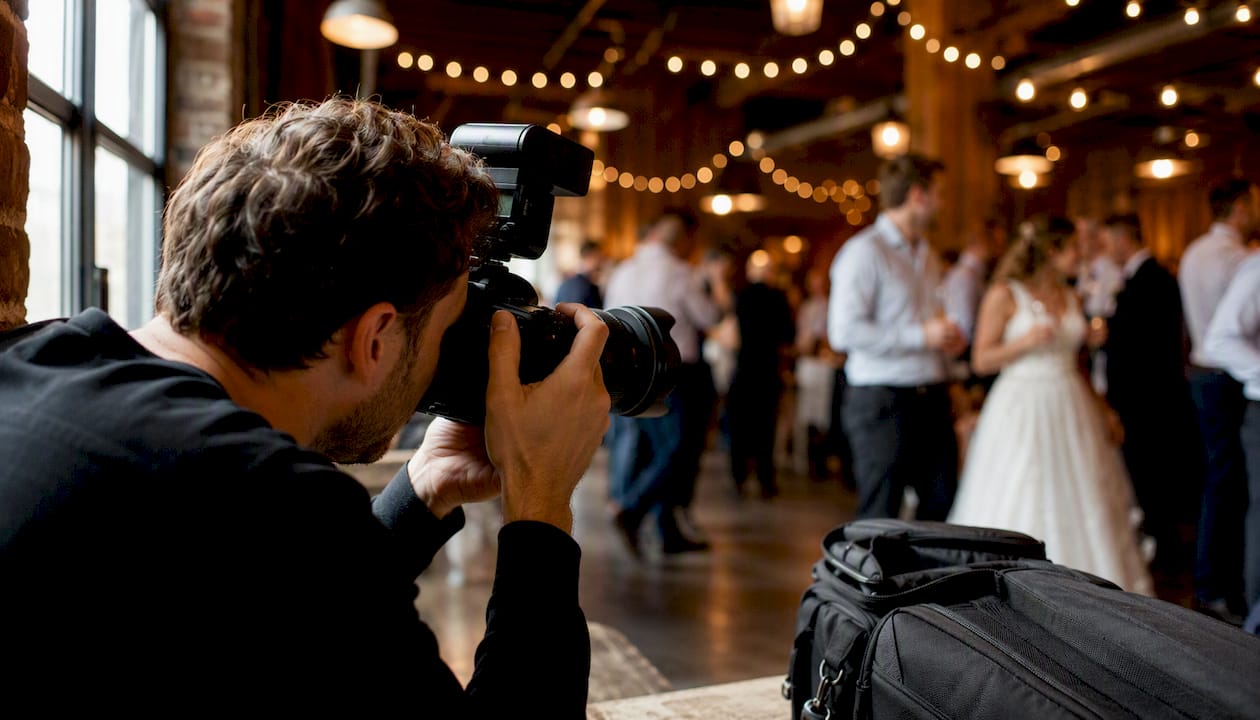
For a bird photographer, that means the camera locks onto the eye of a bird in flight and holds it through erratic direction changes. For a wedding photographer on a busy dance floor, it means the camera finds the couple’s faces in a crowd and keeps them sharp through a full burst. For anyone photographing children or pets, it means fewer missed moments and far fewer frames to cull.
To evaluate AF in a store or rental, try this: set the body to eye-tracking mode, point it at a subject walking toward you at an angle, and watch how the tracking box behaves when the subject turns or is briefly occluded. Then fire a burst and check the keeper rate at 100% crop. That test, done with a native lens, tells you more than any spec sheet.
Pro Tip: Canon EOS R bodies (R5 Mark II, R6 III, R1) and Nikon Z bodies (Z8, Z6III) both offer pre-shoot buffering modes that begin recording frames a fraction of a second before you fully press the shutter. Test that feature specifically for any fast-action work — it changes the odds on decisive moments.
Why mirrorless mount geometry changes what lenses can do
The Nikon Z mount has a 55mm inner diameter and a 16mm flange focal distance. Compare that with the F-mount’s 44mm diameter and 46.5mm flange, and you can see immediately why native Z-mount lenses can be designed with rear elements that sit much closer to the sensor. That proximity lets designers reduce the number of corrective optical elements, which typically means better wide-open sharpness, less vignetting, and more consistent performance across the frame.
Canon’s RF mount follows the same principle, and Sony’s E-mount, though narrower in diameter, benefits from the same short flange advantage.
Adapted DSLR glass vs. native mirrorless lenses — the practical reality:
- Adapted DSLR lenses via FTZ II (Nikon) or similar adapters — generally solid AF performance on current bodies, but no in-lens IS coordination with IBIS, and some older lenses show corner softness the native mount geometry would have avoided.
How does IBIS make a practical difference at events?
In-body image stabilisation works by physically shifting the sensor to compensate for camera movement. When paired with optical stabilisation in the lens, the two systems communicate and divide the correction work, producing steadier handheld shots at shutter speeds that would previously have required a tripod or monopod.
IBIS benefits that change real-world outcomes:
- Handheld portraits at 1/30s or slower in low-light venues without motion blur from camera shake.
- Event candids with a 70–200mm equivalent at shutter speeds that would have been unusable without stabilisation.
- Mixed photo/video work where the operator switches between stills and short video clips without a gimbal.
For video, continuous sensor readout in mirrorless bodies also enables cleaner rolling-shutter performance and higher frame rates, making mirrorless the natural choice for hybrid shooters.
Pro Tip: Before booking a mirrorless body for a long video project, check the manufacturer’s stated recording limits and look for recent firmware notes. Nikon, Canon, and Sony have all addressed overheating in flagship bodies through firmware updates, but the specific limits vary by model and ambient temperature.
What are the real trade-offs you should know before upgrading?
| Factor | Mirrorless | DSLR |
|---|---|---|
| Battery life | Typically moderate shots per charge | Often longer shots per charge |
| Burst rate | Higher sustained rates; pre-shoot buffering available | Lower on most models; mechanical shutter limits apply |
| AF coverage | Full-frame on-sensor PDAF; AI subject detection | Centre-weighted dedicated AF points on most bodies |
| Heat risk | Present in long video takes; varies by model | Lower risk; no continuous readout heat load |
| Used-market value | High new cost; used prices still elevated | Strong used value; DSLR bodies available at a fraction of new mirrorless prices |
The battery gap is the most operationally significant trade-off for event shooters. Field reports consistently show mirrorless bodies consuming power faster than DSLRs, particularly when the EVF is active.
Pro Tip: Carry at least three batteries per mirrorless body for any event over two hours. Rotate them warm rather than waiting for a dead battery warning. For video-heavy jobs, a USB-C power bank that charges the body between takes adds a practical safety net.
Should you upgrade to mirrorless? A Canada-focused checklist
Upgrade if your priorities include AF reliability for moving subjects, video quality, portability, or access to the native lens ecosystems being developed for the next decade. Delay if battery endurance per charge or the cost of replacing a full DSLR lens kit matters more right now — used DSLRs remain genuinely excellent value.
Before committing, work through this:
- Test AF tracking — on a rental body (Sony Alpha a9 III, Canon EOS R5 Mark II, or Nikon Z8) with a moving subject in the lighting conditions you actually shoot in.
How do mirrorless and DSLR cameras compare in low light?
Current mirrorless flagships generally handle high-ISO noise at least as well as their DSLR counterparts from the same sensor generation, and often better because newer sensor fabrication processes tend to appear in mirrorless bodies first. The Sony Alpha a9 III’s global shutter, for example, eliminates rolling-shutter distortion entirely, which changes what is possible at high frame rates in mixed lighting.
The more meaningful low-light advantage for most photographers is the EVF’s ability to brighten the scene artificially for composition, combined with on-sensor PDAF that maintains tracking reliability at apertures and shutter speeds where a DSLR’s dedicated AF module would struggle. At a dimly lit reception or a candlelit gala, that combination produces more keepers than raw sensor noise performance alone.
Does camera size and weight actually change how you shoot?
Mirrorless bodies are generally more compact than equivalent DSLRs, though the gap narrows when you attach large native lenses. The practical effect is real: a lighter kit reduces fatigue over a four-hour event, makes the camera less imposing for candid portraits, and fits more easily into a carry-on bag for destination shoots.
Venue agility matters too. In a tight reception hall or a crowded corporate gala, a smaller body with a fast prime is easier to manoeuvre than a full DSLR kit. How venue layout shapes your photo opportunities is worth thinking through before you choose your kit for any specific event.
Are mirrorless cameras more reliable than DSLRs?
Removing the mirror eliminates the single most mechanically complex moving part in a camera body. DSLRs rely on a precisely calibrated mirror box, a pentaprism or pentamirror, and a separate AF module, all of which require alignment and can drift over time. Mirrorless bodies replace that assembly with a sensor and an EVF, reducing the number of parts that can fall out of calibration.
The electronic shutter in mirrorless bodies also allows completely silent shooting with zero mechanical wear, which extends the functional life of the shutter mechanism. For event photographers who fire tens of thousands of frames per year, that is a meaningful durability advantage.
What is the lens and third-party support situation in Canada?
The native mirrorless ecosystems from Nikon (Z mount), Canon (RF mount), and Sony (E mount) have all grown substantially. Sigma, Tamron, and Viltrox now produce native-mount lenses for Sony E and, increasingly, for Nikon Z and Canon RF, giving Canadian buyers genuine third-party options at mid-range price points. Henry’s and Vistek both stock a reasonable selection of third-party mirrorless glass, and B&H ships to Canada with duties applicable at the border.
The Canon RF mount has historically been more restrictive for third-party manufacturers, though that is changing. If third-party lens access matters to your budget, Sony E-mount currently offers the widest selection of native third-party options in the Canadian market.
Is mirrorless the future, or is this just a trend?
Every major camera manufacturer has committed its professional development roadmap to mirrorless. Nikon’s F-mount DSLR line is no longer receiving new body releases; Canon’s EF-mount is in the same position. Sony has been mirrorless-only in interchangeable-lens cameras for years. The lens investment, firmware development, and sensor innovation are all flowing into mirrorless systems.
For Canadian photographers buying glass today, native mirrorless lenses represent a longer-term investment than DSLR glass, which is now in a slow depreciation cycle as the used market fills with bodies and lenses from photographers upgrading. Features like stacked sensors, global shutters, AI-driven subject detection, and computational photography are all arriving in mirrorless bodies first.
Key takeaways
Mirrorless cameras produce more usable final photos primarily through EVF workflow, full-frame on-sensor AF, and lens-mount geometry that enables sharper native optics — not because the mirror itself changes raw sensor output.
| Point | Details |
|---|---|
| Sensor drives raw quality | Mirrorless vs DSLR raw parity is real when sensor generation matches; upgrade for workflow, not a raw-file leap. |
| EVF saves time and frames | Live exposure and white-balance preview before capture reduces post-production and increases keepers at events. |
| AF and burst rate matter most | On-sensor PDAF with AI subject detection produces more sharp frames of moving subjects than like-generation DSLR AF. |
| Battery life is the main trade-off | Mirrorless bodies typically deliver moderate battery life per charge; carry multiple batteries for any event over extended periods. |
| ZATTU PHOTO BOOTH uses full-frame mirrorless | For Southwestern Ontario events, ZATTU PHOTO BOOTH’s studio-grade mirrorless setup delivers consistent, frame-worthy results without guests needing to own or manage any gear. |
Why professionals who shoot events trust mirrorless systems
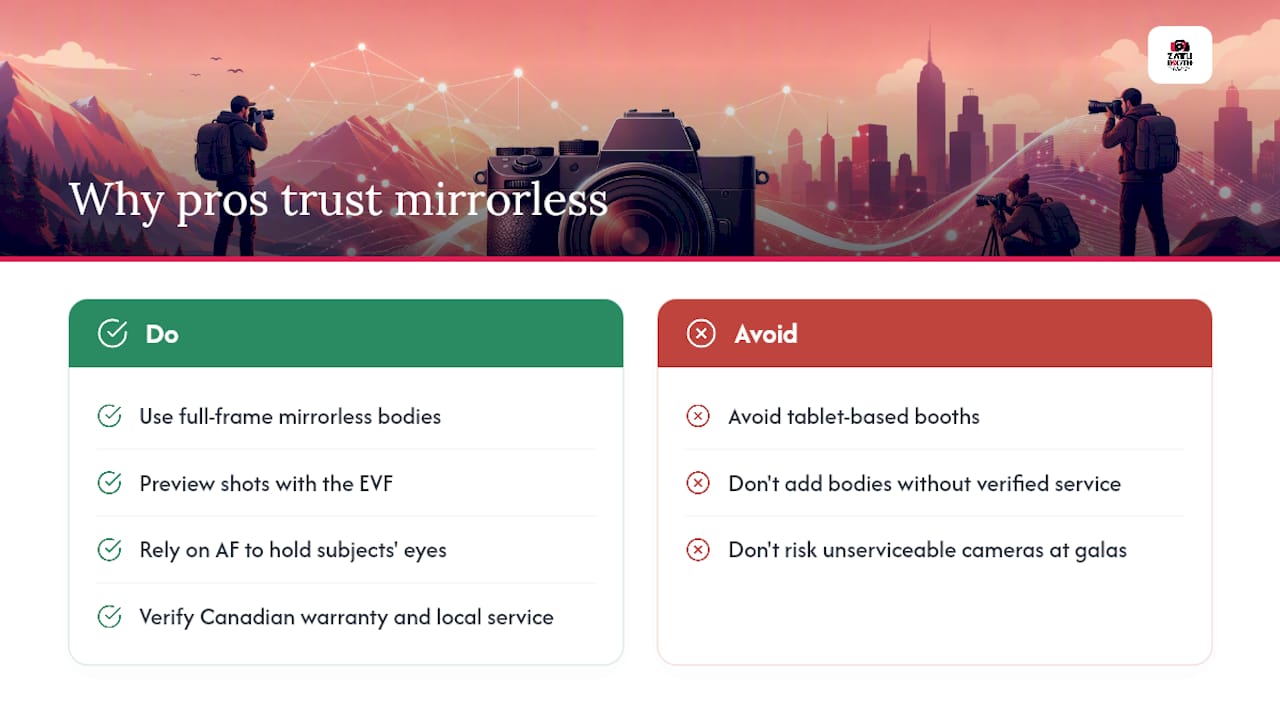
The shift to mirrorless in professional event work is not about chasing specs. It is about single-operator reliability. When you are the only photographer at a wedding reception and the first dance lasts ninety seconds, you cannot afford to miss focus or spend three frames dialling in exposure. The EVF shows you the image before you shoot it, and the AF holds the couple’s eyes through a spin and a dip.
At ZATTU PHOTO BOOTH, we run Nikon full-frame mirrorless bodies in our studio and mirror booths precisely because the AF speed and colour consistency under mixed event lighting produce results that tablet-based booths simply cannot match. The keep rate per session is higher, the colour calibration holds across varied venues, and guests walk away with prints that look like they came from a professional portrait studio. Canadian warranty coverage and local service access for our equipment are non-negotiable for us, because a failed body at a Saturday evening gala is not recoverable. That is why we verify service options before any new body enters our rotation.
Get mirrorless-quality event photos without buying the gear
Upgrading to a full mirrorless kit is the right call for many photographers, but for event hosts who want frame-worthy photos without managing cameras, lenses, or lighting, ZATTU PHOTO BOOTH delivers those results directly. Our booths use Nikon full-frame mirrorless cameras, professional studio lighting, and calibrated colour workflows to produce prints and digital images that go well beyond what a standard tablet booth offers.

Whether you are planning a wedding in Kitchener, a corporate gala in Waterloo, or a birthday celebration in Guelph, our party photo booth rental packages bring mirrorless-grade image quality to your event with zero gear management on your end. We handle setup, operation, and takedown. You bring the fun. Request a quote at zattuphotobooth.ca and we will confirm availability for your date.
Useful sources for Canadian mirrorless buyers
These resources cover the technical and practical ground worth checking before you rent, buy, or book:
- DSLR vs Mirrorless: Which Camera Should You Buy in 2026?
- DSLR vs mirrorless: what’s the difference and which camera is right for you
- How mirrorless cameras work: the complete explanation | Nikon Australia
- Better images with mirrorless | Nikon Australia
- 10 reasons why a pro is using a mirrorless camera for personal and paid jobs
- DSLR vs mirrorless: what’s the difference and which camera is right for you
- DSLR vs mirrorless: Canon EOS R System perspective
- The mirrorless myth: a full-frame DSLR camera will get you the same results, you’ll just have to try a little harder
For Canadian stock and rental availability, Henry’s (henrys.com) and Vistek (vistek.ca) both list current inventory and offer rental programmes. Confirm manufacturer warranty coverage with Nikon Canada, Canon Canada, or Sony Canada directly before purchasing, and ask your local retailer about trade-in credit on existing DSLR equipment.