

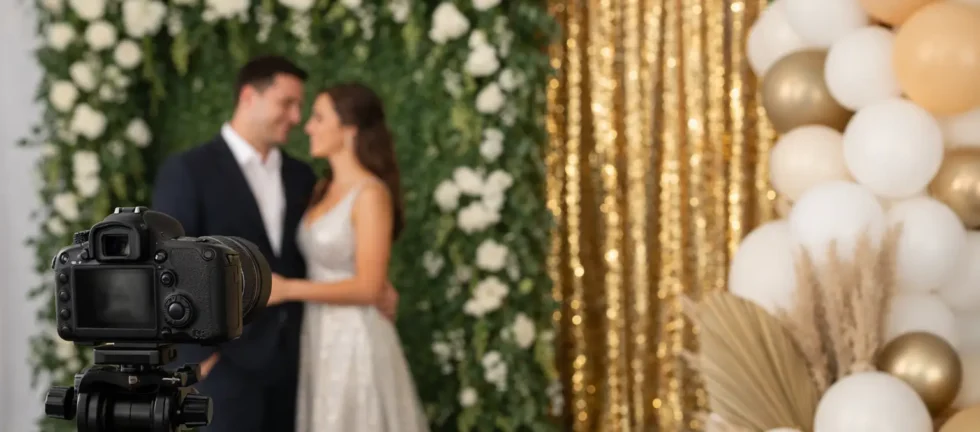
A backdrop is not just decor behind a photo booth. It becomes the setting for hundreds of guest portraits, candid group shots, print keepsakes, and the online gallery people revisit after the event. Knowing how to choose event backdrops means looking beyond a swatch or a pretty online photo and considering how the design will perform under real event lighting, with real guests, in your actual venue.
For weddings, galas, holiday parties, and branded celebrations, the right backdrop helps every image feel intentional. The wrong one can create visual clutter, reflect harsh light, disappear in photos, or compete with the people it is supposed to frame.
Start With the Photos You Want to Keep
Before choosing a color or material, picture the finished photographs. Are you hoping for elegant, editorial-style portraits? High-energy group photos? A branded collection of images guests can share immediately? Your backdrop should support that goal without becoming the main subject.
For a formal wedding, a soft neutral, layered drape, floral treatment, or refined texture often creates timeless photos. For a corporate celebration, a clean branded step-and-repeat or subtle custom graphic may better reinforce the organization while keeping faces front and center. A birthday or holiday party can handle a bolder pattern, metallic finish, or themed installation, provided it still photographs cleanly.
The best backdrops give guests a reason to step into the frame while leaving enough visual breathing room for the people in it. This matters especially when guests arrive in patterned dresses, dark suits, sequined outfits, or colorful holiday attire.
Match the Backdrop to the Event’s Visual Language
Your invitation suite, florals, linens, signage, and print template should feel related, but they do not need to match exactly. In fact, matching every element too closely can make the room feel flat. Think of the backdrop as one coordinated piece of a larger visual story.
If your reception features warm ivory linens, champagne accents, and abundant greenery, a stark bright-white backdrop may look disconnected. A cream, champagne, soft taupe, or botanical design will usually feel more at home. If the event design is modern and high-contrast, a clean black, white, or saturated color backdrop can create a sharper result.
Color is only one part of the equation. Texture can add depth without visual noise. Shimmer walls, velvet drape, sequined panels, layered fabric, wood textures, and dimensional florals all respond differently to flash photography. A texture that looks understated in person can create beautiful depth in a properly lit image. Conversely, a highly reflective surface can produce bright hot spots if the lighting is not planned around it.
Consider the Season, But Avoid the Obvious Choice
Seasonal references can make an event feel cohesive, particularly for Christmas parties and winter weddings. Deep evergreen, black, gold, silver, burgundy, and velvet textures can be striking choices. Still, the most effective seasonal backdrop does not always feature literal snowflakes, ornaments, or themed graphics.
A more refined option often ages better in photographs. A gold shimmer wall can feel festive in December and still look polished in a printed portrait years later. The same principle applies to spring florals, summer colors, and autumn tones. Use the season as inspiration rather than a limit.
Choose a Size That Works for Groups
One of the most common backdrop mistakes is choosing something that looks impressive for one person but feels too small once a group joins the frame. Event guests rarely pose alone all night. Couples, families, wedding parties, coworkers, and friends will naturally gather together.
A backdrop should be wide enough to accommodate your expected group size without exposing unattractive venue walls, service doors, equipment, or empty space at the edge of the image. Height matters too. Tall guests should not appear to tower above the design, and seated guests should still have a finished-looking background.
This is where the photo booth footprint deserves attention. Ask where the booth will be placed, how far guests will stand from the backdrop, and how the camera is framed. A studio-grade camera and professional lighting can produce a more polished image, but they still need a backdrop that fills the composition appropriately. The physical setup and the photographic setup should be planned together.
Think About Lighting Before You Fall in Love With a Finish
A backdrop can look completely different under ballroom uplighting, daylight from windows, overhead venue fixtures, and photo booth strobes. That is why a quick phone photo in a showroom or online listing is not enough to make the final call.
High-gloss materials, mirror finishes, and very shiny sequins can be beautiful, but they require thoughtful lighting placement. When handled well, they add sparkle and dimension. When poorly lit, they can reflect flash directly into the camera and draw attention away from guests’ faces.
Matte finishes are often the safest choice for consistently flattering portraits because they reduce glare. Fabric backdrops, soft drape, paper florals, greenery, and many printed graphic panels can work particularly well with professional lighting. That does not mean reflective options are off-limits. It means they should be selected with the photo experience in mind, not only the room reveal.
At Zattu Photo Booth, professional three-point strobe lighting and a Nikon Z9 camera help create crisp, flattering portraits, but the strongest results always come from pairing that equipment with a backdrop suited to the event environment.
Keep Branding Present, Not Overbearing
For corporate functions, galas, fundraisers, and product celebrations, branded backdrops can turn guest photos into valuable event assets. The challenge is making the brand visible without making every image feel like an advertisement.
A repeating logo pattern works well for red-carpet arrivals and sponsor recognition, particularly when the layout allows enough open space around each guest. For a photo booth experience, a more subtle approach can feel warmer: a custom monogram, event name, brand colors, or themed design paired with a branded print template.
Avoid oversized logos placed where faces will naturally land. Also consider how social sharing changes the image. A backdrop that is readable from across the room may be too busy in a close portrait. Your guests should feel like the focus, while the branding provides context and polish.
Account for the Venue’s Realities
Venue restrictions can shape the best choice more than the mood board does. Some spaces have limited setup windows, low ceilings, historic walls, tight loading access, or strict rules around hanging decor. Others have expansive rooms where a small backdrop can look lost.
Ask practical questions early: Where will the booth be located? Is there enough depth for the backdrop, lighting, camera, and guest line? Will nearby doors or banquet traffic interrupt the experience? Does the venue have strong colored uplighting that may affect the backdrop’s appearance?
Placement is just as important as the backdrop itself. A beautiful design positioned beside a busy bar, open kitchen door, or speaker stack will not create the same elevated experience as one placed in a thoughtful, well-lit area. An experienced photo booth team can help identify a location that feels accessible to guests while protecting the quality of the photos.
Prioritize Quality and Setup Details
A backdrop should look finished from the first photo to the last. Wrinkled fabric, unstable stands, visible clamps, gaps between panels, and uneven drape can show up quickly in professional images. These details are easy to miss in a rushed setup, yet they can affect every print and digital file.
Premium event backdrops are not only about the material. They are about proper tension, secure installation, clean edges, and a setup that remains photo-ready throughout the celebration. If the backdrop includes florals, balloons, or dimensional pieces, make sure it can withstand guest traffic and does not shed, sag, or shift during the event.
It is also worth confirming what is included in the quote. Customization, delivery, setup, teardown, and coordination should be clear upfront. A lower initial price can become less appealing if important finishing details or event-day support are treated as extras.
Let Guest Comfort Guide the Final Choice
The backdrop should invite participation. If it is too elaborate, guests may worry about touching it. If it is too narrow, large groups may avoid the booth. If it is visually chaotic, people may not know where to stand or how to pose.
The strongest designs make the experience feel effortless. They frame guests beautifully, complement the room, and work with the booth’s lighting rather than fighting it. That confidence shows in the photos: relaxed expressions, natural groupings, and keepsakes that feel worthy of the occasion.
When choosing your backdrop, select the one that will still make sense when the music has ended, the flowers are gone, and the photographs are what remain. A well-planned backdrop does more than fill a wall. It gives your guests a polished place to be seen, celebrated, and remembered.