


Here’s your starter checklist: define the event’s purpose in one sentence, confirm your date against the academic calendar, book your venue, set a budget with a 10% contingency, register the event with campus authorities, and name one person who owns the run-of-show. Do these six things this week and everything else on this page becomes execution, not guesswork.
Assign ownership immediately. The club president or event lead usually drives the purpose statement and campus registration. A logistics lead should own the venue and vendor bookings. A finance lead sets the budget and contingency before a single dollar moves. Splitting these roles early prevents the classic student-org failure mode where one overworked person tries to be treasurer, caterer, and security contact at once.
Here’s a mini version you can copy into a task app or print as a handout:
- Write a one-sentence purpose statement and target headcount
- Confirm your date is open on the academic and campus events calendar.
- Reserve your venue and get written confirmation of capacity and inclusions
- Set a total budget figure with a 10% contingency line
- Register the event in your campus system (allow the required lead time).
- Name a single run-of-show owner responsible for day-of decisions
That’s the foundation. The rest of this student activity planning checklist builds out the timeline, the operational detail, and the templates that turn those six lines into an actual event.
Key Takeaways
Successful student event planning depends on registering early, locking a budget with contingency up front, and reconciling every expense within 48 hours of the event’s end.
| Point | Details |
|---|---|
| Register early | Campus systems often require a minimum two-week window; larger events need two to three months. |
| Set a contingency line | Budget roughly 10% extra beyond your core line items before booking anything. |
| Name one run-of-show owner | A single accountable lead per cue reduces day-of confusion more than a shared volunteer pool. |
| Reconcile within 48 hours | Deposit funds and file receipts immediately to avoid personal financial liability. |
| Confirm catering timelines separately | Catering and large service orders often need a full month, longer than routine bookings. |
Notify student life, facilities, and campus safety before anything else, and treat the campus lead time requirement as your single hardest deadline. Download and adapt the printable checklist, run sheet, and budget template outlined above, and copy them into your organisation’s shared drive so the next event lead starts ahead, not from zero.
Table of Contents
- Pre-planning: clarify purpose, approvals and dates
- What’s the ideal timeline for planning a student event?
- Logistics and operations: venue, equipment and accessibility
- How do you promote a student event and track attendance?
- Staffing, volunteers and building a run-of-show
- Budget and finance: line items, funding and reconciliation
- Day-of checklist: from setup to teardown
- Post-event wrap-up: what happens after the doors close
- Templates and downloads for planning your event
- Food, alcohol and safety checks before you promote your event
- Planner’s perspective: what experienced organisers wish they’d known sooner
- Bring the same reliability to your event’s entertainment
- Frequently asked questions about planning student events
- Sources
Pre-planning: clarify purpose, approvals and dates
Before you touch a vendor contact or a poster template, write a one-paragraph event brief. It should state the purpose, the target audience, your top three desired outcomes, and an honest estimate of expected size. A brief this short forces clarity: if you can’t answer “why does this event exist” in one sentence, you’re not ready to book anything yet.
Next, check the academic calendar against your campus events calendar, not just your club’s own schedule. Overlapping exam periods, reading weeks, or a larger campus event on the same night can quietly sink attendance. Campus activities offices routinely note this as a common planning mistake student groups make.
Lead time matters more than most first-time organisers expect. Colorado College’s event planning guidance recommends a two to three month planning horizon for well-prepared student events, with a minimum of notice for standard service orders. The University of Iowa’s event planning process similarly asks organisers to allow two weeks for event submissions, longer if the event recurs across multiple dates.
Notify the right campus offices early rather than at the last minute. Student life typically wants your event brief and expected headcount. Facilities needs your space request and any setup requirements. Campus safety wants advance notice for anything involving large crowds, amplified sound, or evening hours. MIT’s Five Simple Steps for student event planning instructs student groups to register events formally and flags a 10 working day minimum for events with certain features like amplified sound or outdoor space.
Pro Tip: Register your event under a documented club initiative, not an informal group chat plan. Using club status to book discounted space for something that isn’t tied to an actual organisational activity can get your group’s booking privileges suspended, and campus offices check this more often than students expect.
What’s the ideal timeline for planning a student event?
A phased timeline beats a vague to-do list because it forces sequencing. Eventplanning, moving from first decisions through booking, design, lock-down, event week, event day, and the week after, scales down cleanly for a club social and scales up for an all-campus festival. The phases stay the same; only the scope inside each one changes.
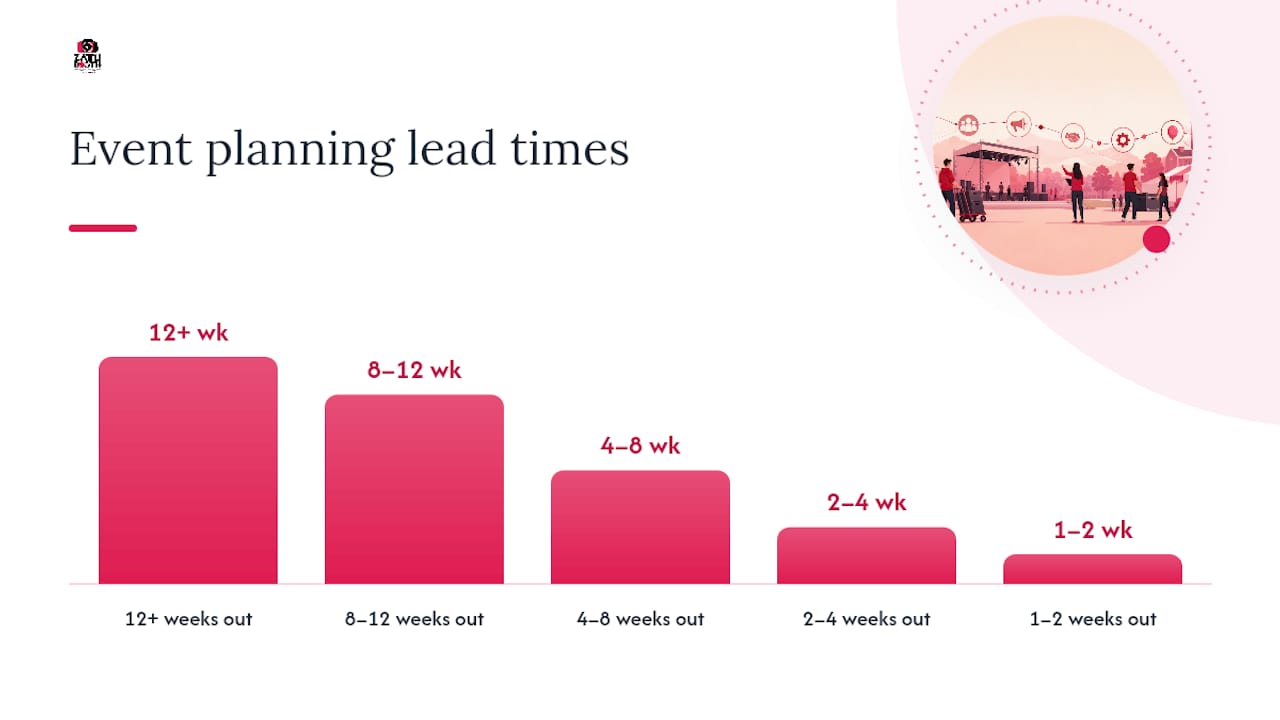
Here’s how that translates into weeks-before buckets for a typical student event:
- 12+ weeks out: finalize purpose, draft budget, check calendar conflicts, shortlist venues
- 8 to 12 weeks out: confirm venue deposit, lock major vendors, submit campus event registration
- 4 to 8 weeks out: secure permits, book A/V and rentals, open registration or ticketing
- 2 to 4 weeks out: confirm catering headcount, finalize sponsor deliverables, start weekly promotion push
- 1 to 2 weeks out: confirm all vendor arrival times, brief volunteers, print signage and run sheets
- Event week: final headcount to caterer, last reminder emails, walk the venue if possible
- Day-of: setup, live troubleshooting, run-of-show execution
- Week after: reconcile finances, send thank-yous, collect feedback
| Timeline bucket | Responsible role | Key deliverable | Recommended lead time |
|---|---|---|---|
| 12+ weeks out | Event lead | Event brief and venue shortlist | Start immediately after date confirmation |
| 8 to 12 weeks out | Logistics lead | Signed venue booking, campus registration filed | At least 2 weeks before submission deadline |
| 4 to 8 weeks out | Finance lead | Permits secured, A/V booked | Minimum 2 weeks for service orders |
| 2 to 4 weeks out | Marketing lead | Registration open, promotion live | 2 to 4 weeks before event date |
| 1 to 2 weeks out | Event lead | Volunteer briefing, printed materials | 1 week before event |
| Day-of | Run-of-show owner | Setup, live execution | Morning of event |
Adapt the scope inside each bucket, not the sequence itself, per the same phased logic EventPlanning.com applies across event types. A 30-person club meetup and a 500-person campus concert both move through the same seven phases; the concert just needs more lead time inside each one.
Logistics and operations: venue, equipment and accessibility
Confirming a venue means more than checking a date on a calendar. Ask about maximum capacity, available power outlets and their amperage, load-in access for equipment, storage for supplies before and after, and whether the venue requires proof of insurance for your group’s activity. Guidebook’s event planning research emphasises confirming exactly what a venue fee includes before you sign anything, since “venue rental” can mean wildly different things depending on the space.

If you’re weighing multiple room options, our guide to types of venues and what they host breaks down what to expect from gymnasiums, ballrooms, and outdoor quads differently.
Your A/V and equipment checklist should cover:
- Sound system and microphones (confirm wired vs. wireless needs)
- Screens or projectors, plus the correct adapters for every laptop that will connect
- Extension cords and power strips, more than you think you’ll need
- Lighting for evening events or dim venues
- Charging stations or a backup battery for phones running registration apps
Accessibility deserves the same rigour as your A/V list, not an afterthought. Check that your venue has step-free entry and exits, confirm seating includes wheelchair-accessible spots near the front, and note whether your registration form asks about dietary restrictions or accessibility needs so you can act on the answers. A welcoming event plans for accessibility from the booking stage, not after someone raises an issue on-site.
For vendor coordination, get every agreement in writing, including what’s covered, the payment schedule, and cancellation terms. Guidebook and EventPlanning.com both stress that a written vendor agreement protects your club if a supplier cancels or underdelivers.
Ask for a written agreement covering responsibilities, what’s included in the fee, and the cancellation policy before you hand over a deposit. A verbal handshake with a vendor is not a contract, and student groups have learned that the hard way when a caterer no-shows two days before a fundraiser.
If your event includes an interactive element like a photo activation, our notes on planning booth placement and floor space planning are worth a look when you’re mapping the room layout.
How do you promote a student event and track attendance?
Choosing a registration method depends on your event’s size and stakes. A free RSVP platform works well for most club events and gives you a headcount without collecting payment friction. Paid ticketing suits fundraisers or formal events where you need revenue tracking and a paper trail. A simple sign-in sheet still works for small, informal gatherings under 30 people, though it gives you the least useful data afterward.
Your promotional push should hit multiple channels rather than relying on one:
- Campus event calendars and student life listing pages
- A social post cadence: teaser post, full announcement, countdown posts, day-of reminder
- Physical flyers in high-traffic buildings, especially near your target audience’s classes
- Cross-promotion with partner clubs whose members overlap with your audience
- Email reminders timed to a decreasing urgency schedule
A workable reminder sequence looks like this: save-the-date at 6 to 8 weeks out, full invitation at 4 weeks, RSVP deadline reminder at 2 weeks, a 48-hour reminder, and a same-day nudge for anyone who registered but hasn’t confirmed. Building interactive moments into your promotion, like previewing a photo booth activation, tends to boost both RSVP rates and social sharing after the fact. If you want deeper tactics on keeping people engaged once they arrive, our piece on guest engagement best practices covers that ground.
Staffing, volunteers and building a run-of-show
Every student event needs a small set of named roles, not a general pool of “volunteers who’ll figure it out.” Assign an event lead, a stage manager or MC coordinator, an A/V lead, a safety officer, someone at registration, greeters for the entrance, and a cleanup lead who stays until the last chair is stacked.
Build your volunteer shift schedule well before the event, and brief every volunteer in person or on a video call shortly before the event itself. A briefing that happens a week early gets forgotten; one that happens the morning of leaves no time to fix confusion.
Your run-of-show template needs four columns: time, action, cue owner, and contingency trigger. Naming a single accountable owner for each line item, rather than “the team,” is what separates a smooth event from a chaotic one. Guidebook’s research on event execution notes that planners who assign one clear cue owner per run-of-show item report noticeably less on-site confusion than those who leave roles ambiguous.
Pro Tip: Print three copies of your run sheet: one for the event lead, one taped inside the registration table, and one with your safety officer. Phones die and Wi-Fi drops; paper doesn’t.
Budget and finance: line items, funding and reconciliation
A workable student event budget needs distinct line items rather than one lump “expenses” figure: venue, catering, A/V and rentals, security or safety staffing, printing and signage, and a contingency line set at roughly 10% of the total. Guidebook’s event planning framework treats setting a budget ceiling and contingency as a foundational step that happens before booking, not after.
Common student funding sources include your student government allocation process, department or faculty sponsorship, alumni association grants, and corporate sponsors looking for campus visibility. If you’re pitching sponsors, come prepared to offer:
- Logo placement on signage, programs, or digital screens
- A social media shoutout package with defined post counts
- On-site branding opportunities, such as personalized event prints that carry a sponsor’s name
- A post-event report showing attendance and engagement numbers
Payment and reconciliation deserve a calendar of their own. Track deposit due dates for the venue and every vendor, collect receipts in one shared folder as they come in rather than after the fact, and finalize your financial reconciliation within 48 hours of the event ending. Waiting longer than that is where paperwork gets lost, and lost receipts frequently turn into personal financial liability for whichever student signed the vendor agreements. Treat the 48-hour window as a hard deadline, not a suggestion.
Day-of checklist: from setup to teardown
The morning of your event is where a good plan either holds or falls apart. A time-blocked checklist keeps the team moving without a dozen people asking the same “what’s next” question.
| Time before opening | Key actions |
|---|---|
| T-minus 4 hours | Site walk-through, confirm vendor arrivals, test all A/V |
| T-minus 2 hours | Set up signage, registration table, and seating layout |
| T-minus 30 minutes | Final tech check, brief greeters and registration staff |
| Opening | Doors open, registration live, run-of-show owner on standby |
Confirm your emergency contacts before doors open: campus security’s direct line, the nearest first-aid station, and the accessible exit routes for your specific venue. Post these where your safety officer and event lead can see them without digging through a phone.
Pack a day-of kit the night before so nobody’s scrambling for tape at T-minus 20 minutes: gaffer tape, permanent markers, phone chargers and a battery pack, a small float of spare cash, printed run sheets, and a basic first-aid kit even if your venue has its own.
Pro Tip: Reconfirm every vendor’s arrival time by phone or text the day before, not just by email a week earlier. A no-show caterer at T-minus 2 hours is a crisis; the same no-show discovered at T-minus 3 days is a solvable problem.
Post-event wrap-up: what happens after the doors close
The week after your event matters almost as much as the week before it. Collect every receipt and deposit any cash float within 48 hours, not “sometime this week.” Finalize outstanding vendor invoices while the details are fresh and before anyone forgets what was verbally agreed on-site.
Run a short feedback loop while attendance is still top of mind:
- Send a brief attendee survey within 48 hours (five questions, two minutes max)
- Hold a debrief with volunteers while their memory of what worked is fresh
- Send personalized thank-yous to sponsors with a summary of attendance and engagement
- File your final financial report and any required post-event forms with student life
Close out the venue itself: confirm the room is left in the state your booking agreement requires, report any damage immediately, and return any keys or access cards. Many campus offices track how well a group closes out a space when deciding whether to approve that group’s next booking, so this step protects your club’s future access as much as your reputation.
Templates and downloads for planning your event
A working event planning checklist setup usually includes four core files: a printable checklist PDF you can check off by hand, an editable run-sheet document for day-of assignments, a budget spreadsheet with formula-driven totals, and sample signage image files sized for your venue’s usual print formats.
| Template | Best fit | Adapt for a small club event | Adapt for a large campus event |
|---|---|---|---|
| Printable checklist | All event sizes | Use as-is | Add extra rows for permits and security |
| Run-sheet document | Any event with a schedule | Keep to one page | Split into multiple owner-specific sheets |
| Budget spreadsheet | Any event with expenses | Fewer line items | Add sponsorship and multi-vendor tracking |
| Signage image files | Events needing wayfinding | One entrance sign | Full wayfinding set plus stage branding |
Keep one master copy of each template in your organisation’s shared drive, version-dated, so the next event lead isn’t hunting through old email attachments. A simple naming convention (event name, date, version number) saves more headaches than it seems worth until the second time your group reuses these files.
Food, alcohol and safety checks before you promote your event
Involve your campus’s environmental health or public health office anytime you’re serving food to more than a handful of people, and do this before you promote the event, not after. Foodsafety recommends coordinating directly with vendors on safe food-handling practices and checking local rules for anything prepared on-site rather than delivered pre-packaged.
Catering timelines often run on a different clock than your other vendors. Colorado College’s checklist and similar campus guides note that catering and larger service orders commonly need a full month of notice, longer than the standard two-week window for smaller service requests. If your event includes a sit-down meal or a multi-station buffet, build that extra lead time into your 4 to 8 week bucket, not your event-week scramble. Partner resources like Wild Foodz’s festive meal offerings guide can help you think through menu formats before you brief a caterer.
Alcohol service raises the stakes further. Check your campus’s specific alcohol policy well before booking, since many campuses require a separate permit, proof of insurance, and staff who’ve completed responsible service training before alcohol can appear at any student-run event. Skipping this step is one of the fastest ways to have an event shut down mid-way through.
Foodsafety.gov’s guidance for events and seasonal gatherings shows that improper food handling at temporary or catered events is a recurring, documented risk, which is exactly why campus health offices ask to be looped in early rather than notified after the fact.
Your run sheet’s safety section should include: first-aid location and kit, campus security’s direct contact number, accessible exit routes, and a designated point person if a medical situation arises. Pair every alcohol-related safety measure with the same rigour you’d apply to food safety, since both carry real liability if skipped.
Planner’s perspective: what experienced organisers wish they’d known sooner
Three mistakes show up again and again in student event planning. The first is assuming a venue is available because it “always has been” without checking the current calendar. Campus spaces get double-booked constantly, and the group that confirms in writing wins the room. The second is last-minute staffing, filling volunteer roles the week of the event instead of two weeks out, which leaves no time to brief anyone properly or find a replacement if someone drops out. The third is paperwork delays: waiting until the week before to register the event or file for a permit, only to discover the campus office needs 10 working days you no longer have.
There’s a real trade-off worth naming honestly: when your timeline gets compressed, either scale down the programming or accept a tighter, riskier schedule. Cutting an extra activation or simplifying the run-of-show almost always beats trying to force a full-scale event through a shortened planning window. A smaller, well-executed gathering builds more credibility for your club’s next event than an ambitious one that falls apart from rushed logistics.
The most underrated skill in student event planning isn’t the big decisions. It’s reconciling finances within 48 hours of the event ending. Student leaders who let receipts and vendor invoices sit for a week routinely find themselves personally on the hook for costs the club budget was supposed to cover, simply because nobody could produce the paperwork. Close the books fast, and you protect both your club’s finances and your own.
Bring the same reliability to your event’s entertainment
A checklist gets your event booked, staffed, and running on schedule. What guests remember afterward is usually the moment they had the most fun, and for a lot of student events, that’s the photo booth line. ZATTU PHOTO BOOTH runs studio-grade mobile booths, mirror booths, and self-serve iPad stations built specifically for the kind of high-turnover, high-energy crowd a campus event draws.
Whether you’re running a fundraiser gala that needs a polished glam photo booth setup, a casual mixer that suits a simple selfie photo booth station, or a formal dance that calls for full studio photo booth quality, ZATTU PHOTO BOOTH’s owner-operators handle setup and teardown as part of the package, one less item on your day-of checklist. Flat-rate pricing means the number in your budget spreadsheet is the number you actually pay, with no surprise line item showing up in your post-event reconciliation.
Frequently asked questions about planning student events
How far in advance should a student organisation start planning an event?
Most campus event offices recommend starting two to three months ahead for a standard event, with a hard minimum of about two weeks for routine service orders like A/V or catering. Larger events with permits, alcohol service, or outside vendors need more lead time on top of that.
What’s the single most important document in a student activity planning checklist?
The event brief. A one-paragraph statement of purpose, audience, and expected size shapes every later decision, from venue size to budget ceiling, and prevents scope creep once vendors start pitching add-ons.
Do I need to register my event with campus authorities even for a small club gathering?
Yes, in most cases. Campus registration systems typically apply regardless of event size, and skipping registration can affect insurance coverage and your club’s standing for future bookings.
How much contingency should a student event budget include?
A 10% contingency line on top of your core budget is a reasonable standard, covering unexpected costs like last-minute equipment rental or extra catering headcount.
Who should I contact first when planning a school activity?
Student life or your campus activities office, followed by facilities for space booking and campus safety for anything involving crowds, amplified sound, or evening hours.
Sources
For campus-specific policies, start with your own student life or campus activities office, since lead times and required permits vary by institution. MIT’s Five Simple Steps guide and the University of Iowa’s event and meeting planning page both offer clear, publicly available frameworks that translate well to other campuses even if the specific systems differ.
For food safety, Foodsafety.gov’s event and seasonal guidance is the most direct reference for organisers serving food at any kind of gathering. For a broader, phase-by-phase planning structure and a free downloadable PDF, EventPlanning.com’s 42-item checklist and Guidebook’s downloadable event checklist both offer templates worth adapting to a student budget and timeline. If your event involves hospitality decisions around guest experience, Wild Foodz’s guide on hospitality customer service is a useful supplementary read for briefing volunteers on tone and guest interaction.
- Event Planning Checklist: 42 Items, 7 Phases (Free PDF)
- Event planning checklist
- Five Simple Steps for Student Event Planning – MIT Division of Student Life
- Food safety by events and seasons