

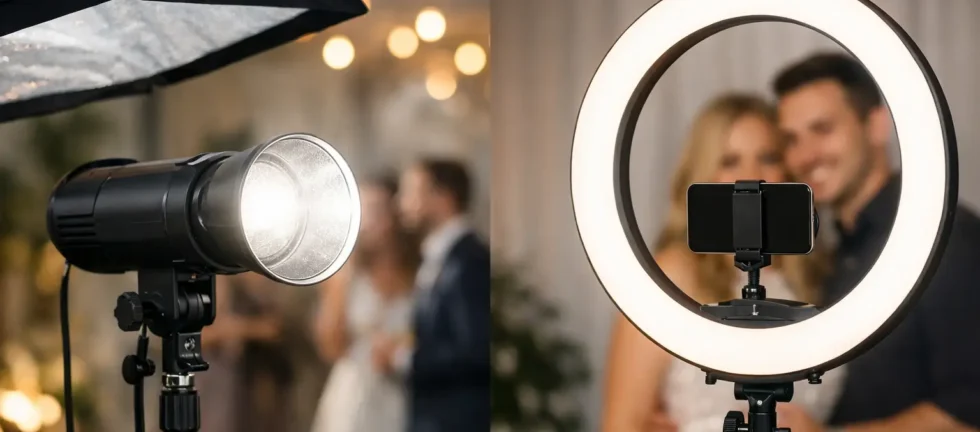
If you have ever compared photo booth galleries and wondered why some look crisp, flattering, and genuinely event-worthy while others feel flat or harsh, the lighting is usually the reason. In the debate around strobe lighting vs ring light, the difference is not just technical – it directly affects how your guests look, how your prints turn out, and whether the booth feels premium or forgettable.
For weddings, galas, corporate activations, and milestone parties, lighting shapes the entire experience. Guests may not know the equipment by name, but they notice the result. Skin looks smoother or shinier. Outfits keep their texture or lose detail. Group shots look polished or uneven. That is why lighting deserves more attention than it usually gets when you are booking a booth.
Strobe lighting vs ring light: what changes in the final photo?
A ring light is exactly what it sounds like – a circular light placed around the camera lens. It creates even frontal light and can be useful for close-up beauty content, casual selfies, and social media clips. Because the light is centered and direct, it tends to reduce shadows and produce a recognizable catchlight in the eyes.
A strobe setup works differently. Instead of one light source aimed straight on, professional strobes are positioned intentionally around the subject. In a three-point setup, the lighting can shape the face, separate guests from the backdrop, and maintain better consistency across different poses and group sizes. The result is usually more dimensional, more balanced, and far more forgiving in a live event setting.
That difference matters because a photo booth is not a controlled studio portrait session with one person leaning toward the lens. It is a fast-moving environment where couples step in together, kids move unexpectedly, coworkers crowd into group shots, and formalwear reflects light in very different ways. The lighting has to adapt without making every image look overexposed, underpowered, or one-dimensional.
Why ring lights work in some settings and fall short in others
Ring lights became popular for a reason. They are simple, compact, and visually familiar. For a solo selfie at close range, they can create a clean, bright look with minimal setup. They are often enough for casual content where convenience matters more than image depth.
But event photography asks more from lighting than convenience. A ring light shines from one central direction, which can flatten facial features and create a very uniform look that does not always translate well to prints. It can also struggle with larger groups because people standing farther from the center may not receive the same quality of light as the person closest to the camera.
There is also the issue of power. Many lower-end ring light setups simply do not have the output needed to freeze movement cleanly in dim venues. That can lead to softer images, inconsistent exposure, or photos that feel more like phone snapshots than professional keepsakes. If your event is elegant, branded, or once-in-a-lifetime, those compromises become more obvious.
None of this means ring lights are useless. They can be perfectly fine for influencer-style content stations, beauty-focused closeups, or casual digital booths where guests expect a quick social media look. The problem comes when a ring light is presented as if it delivers the same result as a true professional lighting setup. It does not.
Why strobe lighting looks more polished at events
Strobes are built for performance. They produce a stronger burst of light, which helps freeze motion and maintain sharpness even when guests are laughing, dancing into frame, or holding props mid-action. At busy events, that reliability shows up in every gallery.
More importantly, strobes give the operator control. Light can be shaped rather than simply blasted forward. With proper placement, faces look more natural, clothing retains detail, and the background does not disappear into muddy shadows or become blown out. This is a major advantage for black-tie events, weddings, and branded corporate functions where presentation matters.
Professional strobe setups also scale better. A single guest, a couple, or a group of six can all be lit more evenly when the system is designed with coverage in mind. That consistency is one of the biggest differences between a premium booth experience and a basic one. Guests should not have to stand in one exact spot and hope for the best.
At Zattu Photo Booth, this is one reason we use three-point strobe lighting rather than relying on a simple consumer-style light source. It supports the kind of crisp, flattering image quality that suits a premium event and holds up beautifully in both prints and digital galleries.
Strobe lighting vs ring light for prints
This is where the gap becomes even clearer. Digital photos are forgiving. People view them on phones, often quickly, and small flaws can go unnoticed. Prints are less forgiving. Once a guest holds the photo in their hand, every lighting choice becomes more visible.
Ring-light images can look bright on screen but still feel thin in print. Skin highlights may appear too shiny, darker clothing can lose texture, and the image may not have enough depth to feel truly professional. If your booth includes instant prints that guests will keep on refrigerators, desks, memory boards, or in wedding albums, the lighting has to support that level of scrutiny.
Strobe-lit images tend to print better because they preserve more shape and separation. Faces look more natural. White dresses, dark suits, sequins, and patterned fabrics all hold up better under controlled lighting. That matters when guests are dressed for a special occasion and expect photos that match the effort they put into the night.
The guest experience matters too
Lighting is not just about the image. It also affects how comfortable and confident guests feel in front of the camera.
A ring light can feel intense because it shines directly at eye level. Some guests do not mind that, but others squint or feel self-conscious under that kind of frontal light. The effect can be especially noticeable for older guests, people wearing glasses, or anyone already a little camera-shy.
A well-designed strobe setup usually feels more natural in use. Because the lighting is shaped around the subject instead of centered in a single bright circle, guests can step in, relax, and focus on having fun. That may sound subtle, but it changes the energy around the booth. People stay longer, try more poses, and leave with photos they are actually excited to keep.
For event hosts, that translates into better engagement. The booth becomes more than a quick stop. It becomes part of the evening your guests remember.
When a ring light might be enough
There are situations where a ring light can be a reasonable choice. If the booth is designed primarily for casual digital sharing, if the venue already has strong ambient light, or if the goal is a low-key selfie station rather than a premium photo experience, a ring light may do the job.
It can also fit certain aesthetic choices. Some brands or parties want a more informal, social-content feel, and the flatter ring-light look may align with that. If expectations are clear, there is nothing wrong with choosing simplicity.
The key is knowing what you are paying for. If you want gallery-worthy images, professional prints, flattering group shots, and a setup that feels elevated, a ring light is usually not the strongest choice.
How to choose the right lighting for your event
Start with the outcome, not the equipment label. Ask what kind of photos you want guests to take home. If the answer includes polished prints, sharp group shots, flattering light, and a booth that feels like a premium part of the event rather than an afterthought, professional strobe lighting is the better fit.
Then consider the environment. Ballrooms, dim reception spaces, corporate venues, and evening events all put more pressure on the lighting system. A setup that performs well in a bright living room may not perform well under event conditions.
Finally, ask how the booth provider handles consistency. Great lighting is not just about owning better gear. It is about knowing how to position it, balance it, and use it to create reliable results all night long. That is the difference between equipment that sounds impressive and service that actually delivers.
When you are choosing between strobe lighting vs ring light, you are really choosing between two very different standards of image quality. One is built for convenience. The other is built for results. If your event deserves photos that feel as polished as the occasion itself, better lighting is not an extra – it is part of getting it right.
The best photo booth photos should make guests look like the best version of themselves, with no guesswork and no disappointment when the print comes out.