

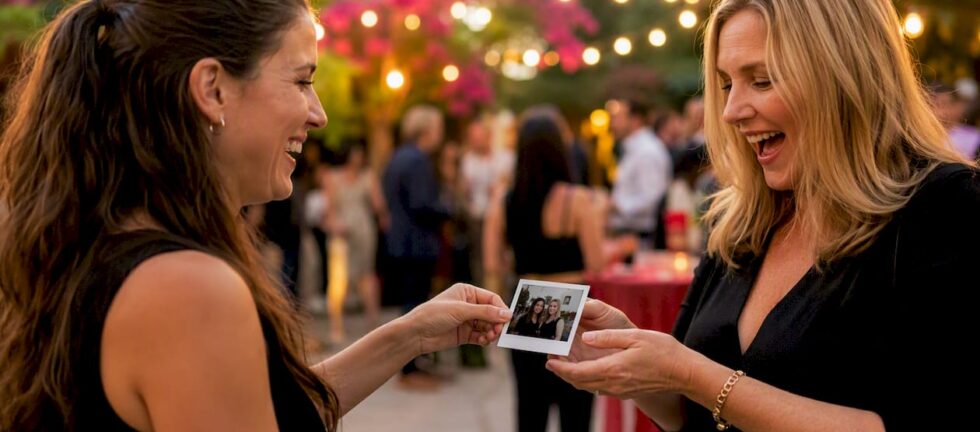
Photo keepsakes can measurably improve donor retention when they are personalised to the donor’s relationship stage, timed within the stewardship cycle, and tracked against a defined baseline. AFP/Fundraising Effectiveness Project benchmarks show overall sector retention sitting near 43% and first-time donor retention near 19%, which means even a modest lift compounds dramatically over a donor’s lifetime. The role of photo keepsakes in donor retention is not decorative; it is a stewardship intervention grounded in memory science and measurable in your CRM.
- Photo keepsakes work best at galas, recognition events, and major-donor stewardship visits.
- They underperform when distributed without personalisation or follow-up messaging.
- The fastest way to test their value: run a single-event A/B pilot (prints vs. no print) and measure repeat-gift rate at six months.
Pro Tip: At your next fundraising event, split attendees into two matched groups by gift history. Give one group a branded instant print; give the other a standard thank-you card. Pull retention data at 90 days and 180 days. That one experiment will tell you more than any benchmark.
Key takeaways
Photo keepsakes improve donor retention most reliably when they are personalised by segment, distributed within 48 hours, and measured against a defined baseline cohort over 6–12 months.
| Point | Details |
|---|---|
| Retention baseline is low | AFP/FEP data shows first-time donor retention near 19%; small lifts compound significantly over a donor’s lifetime. |
| Psychology supports keepsakes | Field studies report 15%–35% donation increases when photo-taking is part of the giving moment, driven by identity preservation. |
| Segment before you spend | Match keepsake format and cost to donor tier: digital for small-dollar, instant print for mid-level, framed print for major donors. |
| Measure with two cohorts | Track retention rate and repeat-gift rate at 90 and 180 days against a control group to calculate real ROI. |
| ZATTU PHOTO BOOTH for pilots | ZATTU PHOTO BOOTH provides studio-grade instant prints, digital delivery, and on-site staffing for fundraising events in Southwestern Ontario. |
Table of Contents
- Why donor retention is the highest-leverage metric for your stewardship budget
- What research says about photo keepsakes and donation behaviour
- Which donors should receive photo keepsakes, and how do you personalise by segment?
- What keepsake formats work best, and when should you use each one?
- Step-by-step checklist to run a keepsake stewardship pilot
- How to measure impact, estimate costs, and calculate ROI
- When should you produce keepsakes in-house, and when should you hire?
- What keepsakes actually changed in donor relationships
- ZATTU PHOTO BOOTH brings studio-grade keepsakes to your fundraising events
- Sources
Why donor retention is the highest-leverage metric for your stewardship budget
Acquiring a new donor costs five to ten times more than retaining an existing one. When sector data shows first-time retention at 19%, the math is stark: most donors you work hard to acquire never give a second time. Lifting retention rates by a meaningful margin can substantially increase a donor’s lifetime value, since subsequent gifts do not incur new acquisition costs.
Keepsakes map onto four stewardship pillars:
- Acknowledgement: a branded photo delivered within 48 hours confirms the donor’s presence mattered.
- Recognition: a framed print or photo card signals that their contribution is worth commemorating.
- Engagement: a physical keepsake stays in a home or office, generating repeat impressions no email can match.
- Impact reporting: a photo showing the cause in action turns abstract giving into visible proof.
Sector benchmark: AFP/FEP data places overall donor retention near 43% and first-time donor retention near 19%. A stewardship programme that raises first-time retention to 30% can generate substantial incremental revenue without adding a single new name to your acquisition list.
Pro Tip: Before budgeting any keepsake programme, calculate your average donor lifetime value by gift tier. A $25 annual donor with a five-year retention curve has a very different ROI ceiling than a $500 mid-level donor. Match keepsake spend to that ceiling, not to production cost alone.
What research says about photo keepsakes and donation behaviour
The psychological mechanism behind photo keepsakes and giving is well-documented. Research published in the Journal of Marketing links memory-preservation techniques, including photography, to reduced identity loss and a higher likelihood to donate. When donors feel their connection to a cause is preserved rather than severed, the emotional barrier to giving again drops.
Field experiments reported by the American Marketing Association found donation increases in the 15%–35% range when donors were prompted to photograph sentimental items before donating. University residence-hall experiments replicated this effect across different contexts, suggesting the result is robust rather than situational.
Research signal: AMA-summarised field studies report 15%–35% donation increases when photo-taking is part of the giving moment, grounded in the identity-preservation mechanism the Journal of Marketing study maps out.
Three practical implications for fundraisers:
- Giving donors a photo at the moment of their gift reinforces their identity as a supporter, not just a transaction.
- Photo proof of impact (a child receiving a meal, a habitat restored) activates warm-glow giving on the next ask.
- Platform data from Givelink shows donors who receive photo proof of delivery give approximately 60% more times per year than those using traditional giving methods, pointing to visibility at the moment of giving as a structural retention fix.
Which donors should receive photo keepsakes, and how do you personalise by segment?
AFP recommends segmenting by gift size, tenure, and acquisition channel because treating every donor identically drives churn. The same logic applies to keepsake stewardship.
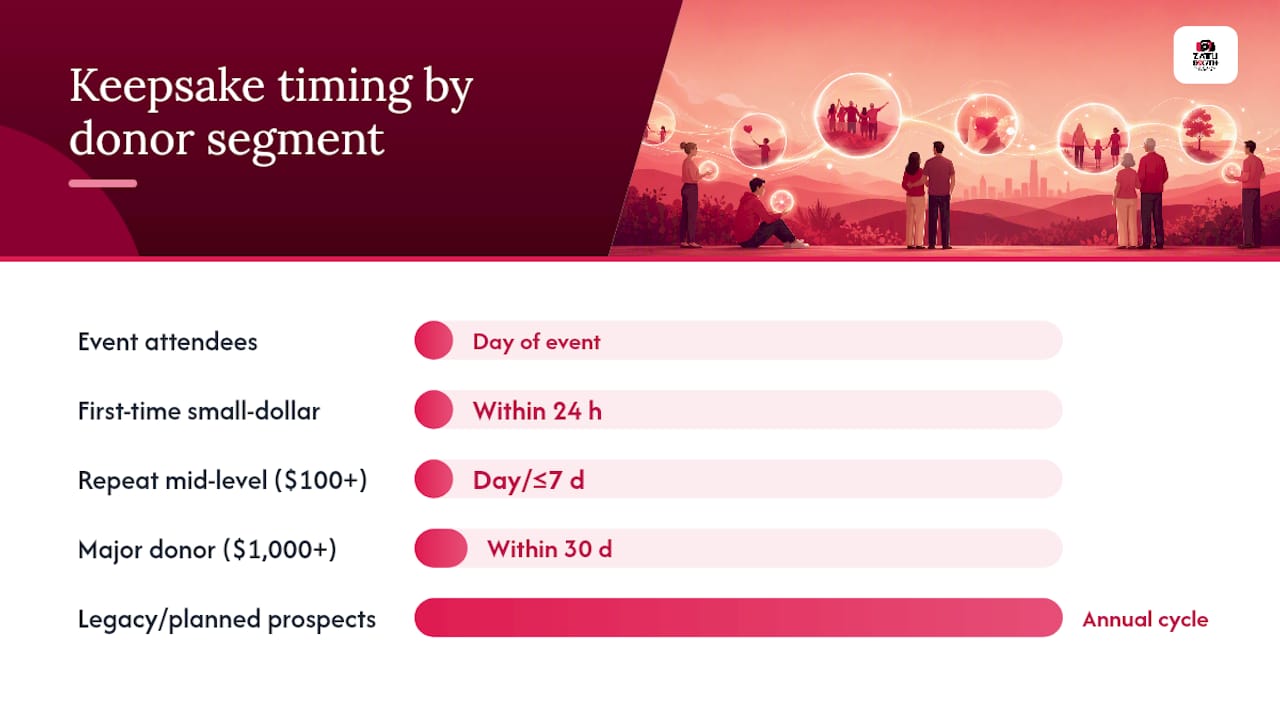
| Segment | Keepsake type | Timing | Sample message angle |
|---|---|---|---|
| First-time, small-dollar | Branded digital photo (email) | Within 24 hours of event | “Your first gift made this moment possible.” |
| Repeat mid-level ($100 and up) | Instant print, mailed photo card | Day of event or within 7 days | “You’ve been with us for [X] years — here’s what that looks like.” |
| Major donor ($1,000 and up) | Framed print or photo book, hand-delivered | Within 30 days of stewardship visit | “We wanted you to see the impact you made.” |
| Event attendees (general) | Instant print at booth | Day of event | “Thank you for being here tonight.” |
| Legacy/planned giving prospects | Curated photo book or commemorative panel | Annual stewardship cycle | “Your legacy is already taking shape.” |
Pro Tip: Add one personalisation field to every keepsake: the donor’s first name and cumulative giving milestone (“Your 3rd year of support”). That single variable, tested against a generic version, typically outperforms on repeat-gift rate. Test it on 200 donors before scaling.
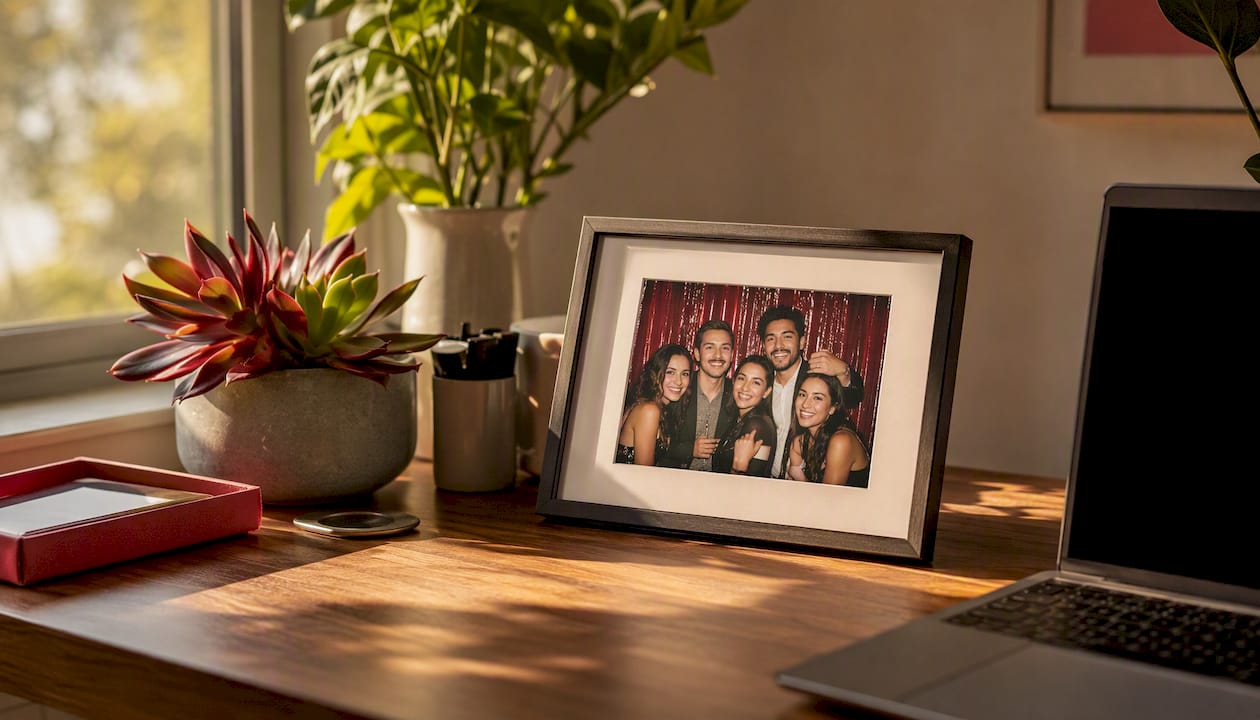
Keepsakes also become physical reminders that raise the probability of repeat contact and social sharing. A framed photo on a donor’s desk is a touchpoint your next appeal letter will never replicate.
What keepsake formats work best, and when should you use each one?
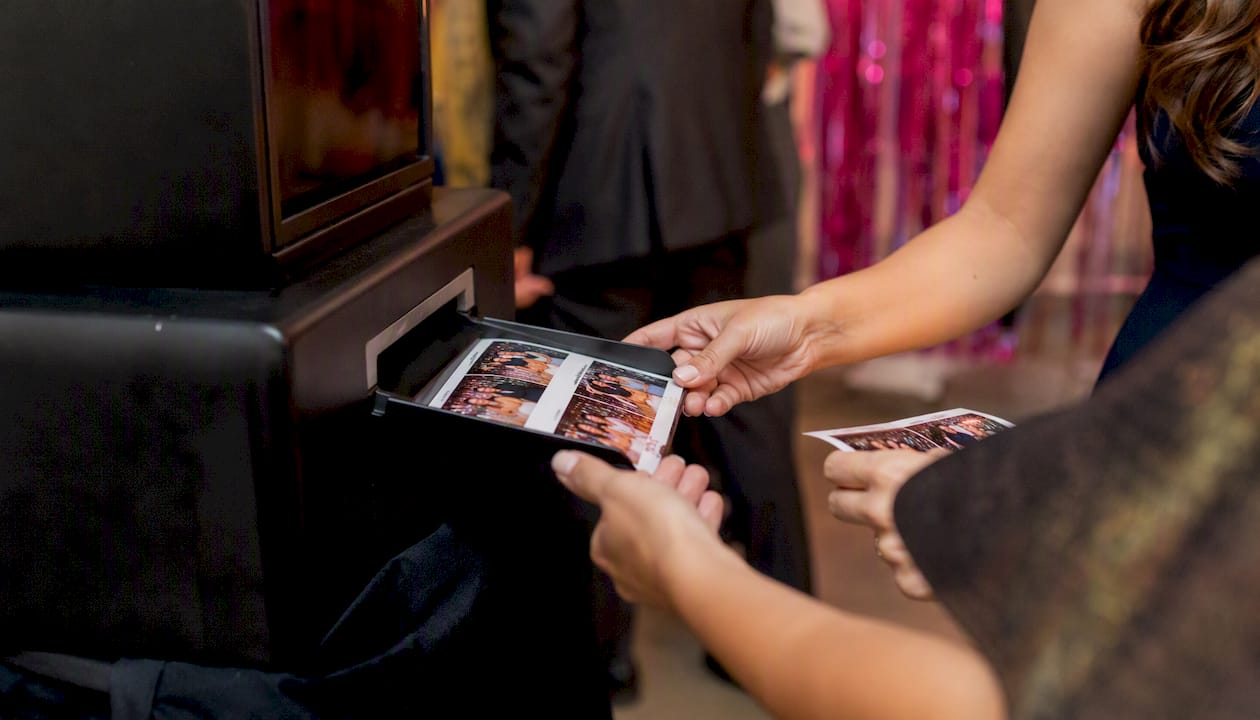
Instant prints are the workhorse of event-based stewardship. They are produced on-site, handed directly to the donor, and carry the highest perceived immediacy. Best for galas, recognition dinners, and community fundraisers where photo booths increase guest engagement and create a natural moment of celebration.
Digital photo delivery suits first-time and small-dollar donors where mailing costs are hard to justify. A branded digital image sent within 24 hours, paired with a personalised thank-you email, covers the acknowledgement pillar at minimal cost. Pair it with digital sharing options that let donors post to social media, extending your reach organically.
Framed prints and photo books carry the highest perceived value and belong in major-donor stewardship. Production lead time runs 7–14 days for a quality framed print and 10–21 days for a photo book, so plan distribution around your stewardship visit calendar, not your event date.
Photo cards and commemorative magnets sit in the mid-range: affordable enough for mid-level segments, personal enough to feel considered. Mail them within seven days of the event for maximum relevance.
Numbered production and distribution sequence:
- Capture photos at the event (booth or roaming photographer).
- Select and brand images within 24 hours.
- Deliver digital versions immediately; queue print orders same day.
- Mail physical keepsakes within 7 days for mid-level; schedule major-donor delivery personally.
- Send a follow-up message referencing the keepsake within 30 days.
Guest experience principles drawn from hospitality research confirm that personalised physical touchpoints extend the emotional memory of an event well beyond the night itself, which is exactly the retention mechanism you are trying to activate.
Step-by-step checklist to run a keepsake stewardship pilot
- Define your objective. Retention lift, repeat-gift rate, or donor satisfaction score? Pick one primary KPI.
- Choose your target segment. First-time event attendees are the easiest cohort to isolate.
- Set your baseline. Pull 12-month retention and repeat-gift data for that segment before the pilot.
- Design the keepsake. Brand the print or digital image with your logo, event name, and a short impact line.
- Select your vendor. Confirm image quality, on-site staffing, print turnaround, and digital delivery capability.
- Capture consent. At registration or check-in, collect written or digital photo consent. For digital delivery via email, collect opt-in consent under Canada’s Anti-Spam Legislation (CASL). Sample language: “I consent to receiving a photo from tonight’s event by email and to being contacted by [Organisation Name] about future events and giving opportunities.” Store consent records in your donor database.
- Distribute keepsakes on the timeline matching the donor segment (see the segment table above).
- Send a follow-up message referencing the keepsake within 30 days. Personalise by name and gift milestone.
- Pull metrics at 90 days and 180 days. Compare retention rate, repeat-gift rate, and average gift size against your baseline cohort.
- Evaluate and scale. If the pilot cohort outperforms the control by a statistically meaningful margin, expand to the next segment.
Pro Tip: Keep your pilot small and clean. One event, one segment, one keepsake format. Complexity kills pilots. A 200-person gala with a clear control group gives you enough data to make a confident decision.
Personalised acknowledgement within 48 hours of a gift is one of the strongest predictors of first-time donor retention. Build your keepsake distribution timeline around that window wherever possible.
How to measure impact, estimate costs, and calculate ROI
Track these primary metrics for any keepsake programme:
- Donor retention rate (keepsake cohort vs. control cohort, 12 months).
- Repeat-gift rate (percentage of keepsake recipients who gave again within 180 days).
- Donor lifetime value uplift (average gift size × projected retention years, compared across cohorts).
- Recapture rate (lapsed donors reactivated after receiving a keepsake mailing).
- Engagement signals (email open rate on follow-up, social shares of digital photo).
Beacon Design recommends tracking donor satisfaction alongside financial metrics, using post-event surveys and feedback tools to capture qualitative signals that explain the numbers.
| Scenario | Cost per keepsake | Retention lift | Incremental donors retained (per 100) | Estimated incremental revenue* |
|---|---|---|---|---|
| Digital photo only | $2–$5 | 1%–3% | 1–3 | Depends on avg. gift |
| Instant print (event) | $8–$15 | 3%–7% | 3–7 | Depends on avg. gift |
| Framed print (major donor) | $40 and up | 7%–15% | 1–2 per major-donor cohort | High per-donor LTV |
*Revenue depends on your average gift size and donor lifetime value. Calculate breakeven by dividing total keepsake programme cost by (incremental donors retained × average lifetime value).
Sector context: With first-time retention at 19% per AFP/FEP data, even a 3-percentage-point lift on a 500-person first-time donor cohort means 15 additional retained donors — each with years of future giving ahead.
When should you produce keepsakes in-house, and when should you hire?
DIY works when your team has a capable DSLR or mirrorless camera, consistent lighting, a dye-sublimation printer, dedicated staff on event night, and a data-capture workflow that feeds directly into your CRM. Miss any one of those, and quality drops fast.
Hire a professional provider when:
- Your event has more than 100 attendees and you cannot staff a photo station without pulling team members from donor relations.
- You need branded prints with consistent colour accuracy across hundreds of copies.
- You want digital delivery with a shareable link and engagement tracking.
- Your major-donor stewardship requires frame-worthy image quality, not a smartphone snapshot.
Vendor checklist when procuring:
- Full-frame camera and professional lighting (not tablet-based).
- On-site staffing by the operator, not a subcontractor.
- Instant print capability with branded template options.
- Digital delivery with opt-in consent workflow built in.
- Turnaround time commitment for physical prints.
- Sample proofs from comparable events before you sign.
- CASL-compliant consent capture and record-keeping.
Pro Tip: Ask any vendor for sample prints from a recent gala or fundraiser. Image quality at 4×6 print size reveals everything about their camera and lighting setup. A tablet-based booth will show grain and flat colour at that size; a full-frame mirrorless system will not.
What keepsakes actually changed in donor relationships
ZATTU PHOTO BOOTH brings studio-grade keepsakes to your fundraising events
Your donors deserve more than a stock thank-you email. ZATTU PHOTO BOOTH brings Nikon full-frame mirrorless cameras, professional lighting, and instant-print capability directly to your fundraising event in Southwestern Ontario, producing frame-worthy keepsakes your donors will keep long after the night ends.
We handle everything on-site: setup, staffing, branded print design, digital delivery with shareable links, and a consent-capture workflow you can feed straight into your donor database. Whether you need a glam photo booth for a VIP recognition dinner or a studio-grade event photographer for curated major-donor portraits, we have the equipment and the experience to make every keepsake count. Our flat-rate pricing means no surprises, and our owner-operated model means the person who quoted your event is the person running it on the night.
Ready to run your first keepsake pilot? Zattuphotobooth and we will help you design a stewardship activation that fits your event, your segment, and your retention goals.
Sources
- Donor Retention Strategy for Fundraising Teams (2026) | AFP Career Center | Find Fundraising Jobs | Association of Fundraising Professionals
- Can Encouraging Picture-Taking Increase Donations of Used Goods? — AMA
- 7 Donor Retention Strategies That Actually Work in 2026
- Measuring the Impact of Your Custom Keepsake Program: Metrics & Feedback Tools | Beacon Design