

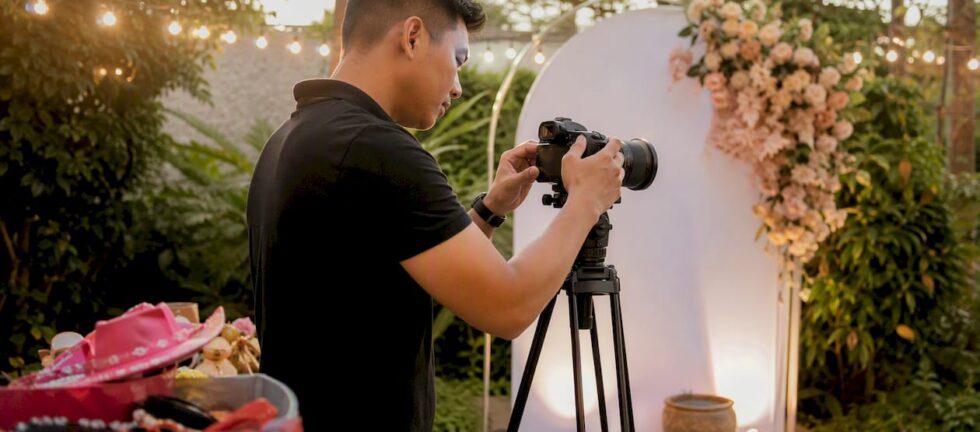
A premium photo booth rental comes down to six non-negotiable differentiators: a studio-grade camera with professional lighting, owner-operated attendants, a range of booth formats (studio, glam, mirror, AI, roaming, and iPad), custom branding with premium keepsakes, transparent flat-rate pricing, and documented contingency and insurance coverage. If a vendor cannot speak clearly to all six, they are not offering a premium service, regardless of how their website looks.
Here is the quick checklist to scan any vendor against:
- Studio-grade camera (DSLR or full-frame mirrorless) with professional lighting
- Owner-operated or named professional attendant on site for the full event
- Multiple booth formats available to match your event type
- Custom branding options: overlays, backdrops, branded prints
- Flat-rate pricing with inclusions listed in writing, plus GST/HST treatment stated
- Insurance certificate available on request, with a named contingency plan
ZATTU PHOTO BOOTH, serving Southwestern Ontario, is the local specialist to benchmark each of these differentiators against in practice.
Key takeaways
A premium photo booth rental is defined by six verifiable differentiators: studio-grade camera and lighting, owner-operated service, format flexibility, custom branding, transparent flat-rate pricing, and documented insurance and contingency coverage.
| Point | Details |
|---|---|
| Camera and lighting floor | Below 50 lux, a full-frame sensor and CRI 90+ lighting materially improve image quality and share rate. |
| Owner-operated reliability | An on-site owner-operator resolves equipment issues in real time; subcontracted staff cannot match that response. |
| Format-to-event matching | Studio and glam booths suit low-light receptions; roaming and 360 rigs serve brand-first activations; iPad stations handle high-throughput daytime use. |
| Flat-rate inclusions | A genuine flat rate covers setup, operator, prints, digital delivery, travel, and taxes; all else is a stated upsell. |
| ZATTU PHOTO BOOTH | Offers studio-grade, owner-operated booths across Southwestern Ontario with guaranteed equipment lists and transparent pricing. |
Table of Contents
- What do premium photo booth differentiators actually deliver?
- What questions should you ask a photo booth vendor?
- Which booth type suits your event?
- Which camera and lighting specs actually matter?
- What are the practical logistics to confirm before booking?
- What should a flat-rate package include?
- How do you verify that a vendor’s premium claims are real?
- Why we choose studio-grade gear and owner-operated service
- ZATTU PHOTO BOOTH: studio-grade booths for Southwestern Ontario events
- Sources
What do premium photo booth differentiators actually deliver?
“Premium” is not a price tier. It is a set of specific choices that change what guests experience and what you walk away with.
Studio-grade cameras and professional lighting are where image quality is won or lost. Share rate, the percentage of sessions where guests actually share or download their photos, rises when light is flattering, output is consistent, and the session takes under 30 seconds. Flattering light is not accidental; it comes from deliberate equipment choices. A full-frame mirrorless camera paired with a fast prime lens and a high-CRI continuous light produces skin tones that guests want to post. A tablet camera in a poorly lit corner does not.
Owner-operated attendants matter because they make decisions. When a backdrop shifts, a print jams, or a guest needs help with the share screen, an owner-operator fixes it in 90 seconds. A third-party subcontractor calls someone. That gap in response time is the difference between a smooth event and a line of frustrated guests.
Booth format flexibility lets you match the experience to the event. A wedding reception calls for something different than a trade-show activation. Knowing which format serves which context is a sign of an experienced vendor.
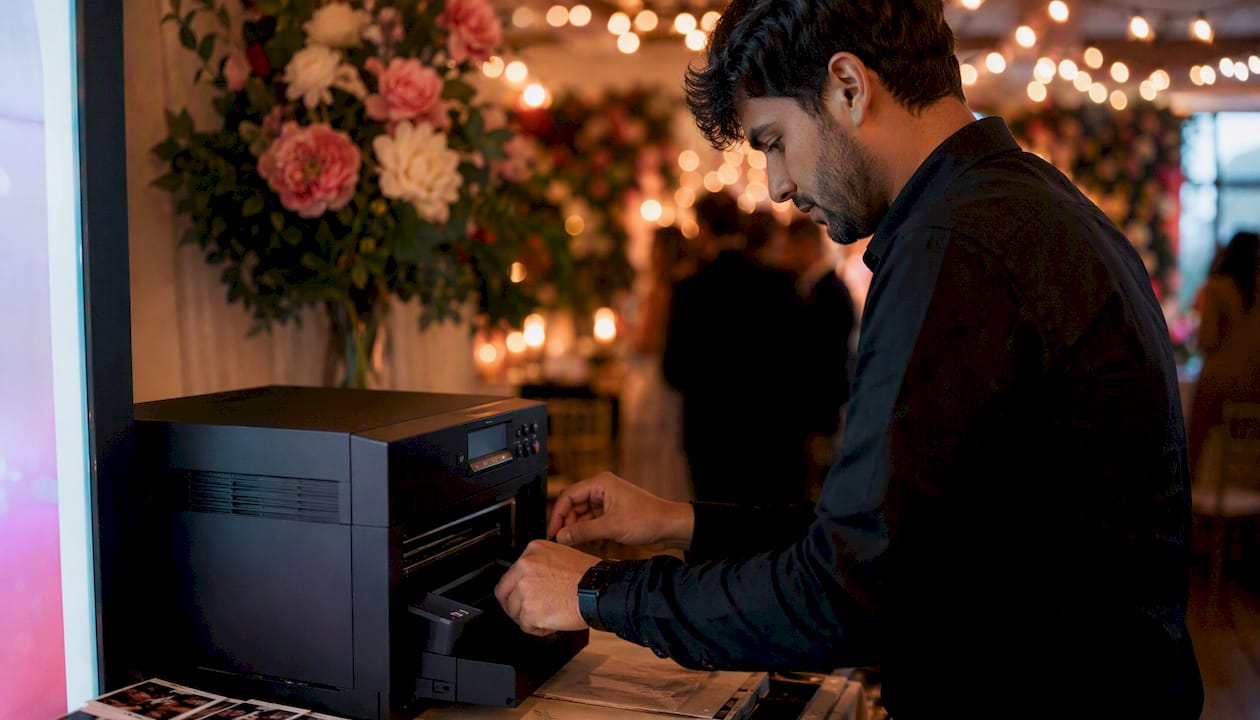
Custom branding and premium keepsakes turn a fun moment into a lasting impression. Personalised print templates, branded overlays, and same-day albums give guests something tangible. For corporate activations, co-branded prints become a marketing asset that travels home with every attendee.
Transparent flat-rate pricing removes the anxiety of hidden fees. A genuine flat rate covers setup, the operator, prints, digital delivery, travel within the service area, and taxes. Anything outside that scope should be listed as an explicit upsell, not discovered on the invoice.
Data privacy and contingency coverage matter most for corporate clients. Clear terms on who owns the images, how long files are stored, and what happens if equipment fails mid-event are not optional extras. They are baseline professional practice.
Pro Tip: Ask every vendor to send you their photo usage rights policy in writing before you book. A vendor who hesitates on this question is telling you something important.
What questions should you ask a photo booth vendor?
Use this sequence on every vendor call. It takes about ten minutes and filters out non-premium offers quickly.
- What is the exact camera model and sensor type you use?
- What lighting system do you use, and what is its CRI rating?
- Will the owner or operator be on site for the full event, or do you subcontract?
- What does your flat rate include, specifically: prints, digital files, travel, setup, taxes?
- What booth formats do you offer, and which do you recommend for my event type?
- Can you provide a sample branded template and a portfolio of prints from similar venues?
- Do you carry liability insurance, and can you provide a certificate?
- What is your contingency plan if equipment fails during the event?
- What are your data retention and photo usage rights policies?
- What are your space and power requirements, and how long does setup take?
Red flags to watch for:
- Vague answers on camera model (“we use a professional camera”)
- No mention of CRI or lighting type
- Subcontracted attendants with no named on-site contact
- Flat rate that excludes prints, travel, or taxes
- No insurance certificate available
- No written contingency plan
- Setup time quoted at under 30 minutes for a full studio rig
Which booth type suits your event?
Matching the booth format to the event is one of the clearest premium venue service differentiators. The wrong format in the right venue still underdelivers.
| Booth type | Best for | Image quality and equipment | Attendant level | Customisation and keepsakes | Logistics |
|---|---|---|---|---|---|
| Studio / stationary DSLR | Weddings, galas, low-light receptions | Full-frame camera, softbox or LED panel, highest print quality | Owner-operator recommended | Full branding, prints, albums | Larger footprint, 60–90 min setup |
| Glam / mirror | Boutique receptions, milestone birthdays | Ring light, high-CRI continuous, excellent skin tones | Professional attendant | Branded overlays, instant prints | Moderate footprint, 45–60 min setup |
| Roaming / 360 / AI | Corporate activations, brand-first events | Varies; motion content prioritised | Operator essential for crowd management | Social-first output, GIFs, branded frames | Minimal fixed footprint, flexible |
| iPad / selfie station | Daytime conferences, high-throughput secondary units | Tablet camera, ring light | Self-serve or light attendant | Digital delivery, basic overlays | Compact, fastest setup |
DSLR and mirrorless booths command higher day rates and perform better in low light and for printed keepsakes. iPad stations are lighter, faster to deploy, and well-suited to daytime, high-throughput bookings. For corporate activations that need both motion content and high-quality stills, a hybrid rig combining continuous light for video and strobe for stills is the professional standard, provided the Kelvin values are matched between both sources.
For a deeper look at current format trends including 360 and AI filter workflows, the photo booth trends 2026 guide covers what is gaining traction in the Ontario market.
Which camera and lighting specs actually matter?
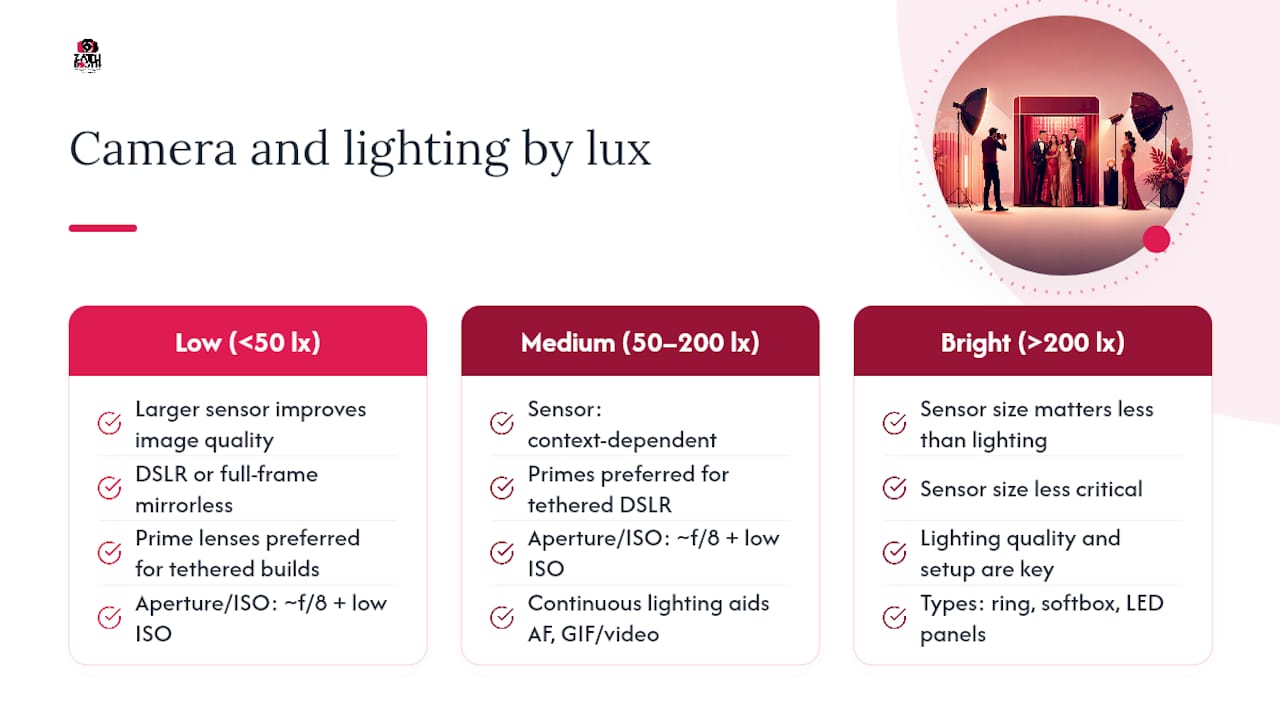
Sensor size is context-dependent. Above roughly 200 lux, camera sensor size matters less than lighting quality and setup. Below roughly 50 lux, a larger sensor (DSLR or full-frame mirrorless) with an appropriate lens materially improves image quality. Most evening receptions in Southwestern Ontario run well below 50 lux at the capture position, which is why sensor size is a genuine differentiator for wedding and gala work.
Aperture and lens choice follow from that. A starting point of around f/8 paired with low ISO and controlled continuous light improves group sharpness, but it demands adequate light output from the rig. Prime lenses are preferred for tethered DSLR builds because they are mechanically simpler and more reliable than extending zooms, which can fail when the barrel contacts an enclosure cutout.
Lighting type should match venue class: ring lights for compact glam setups, softboxes for groups, LED panels for mixed ambient environments. CRI 90+ is the practical floor for accurate skin tones; CRI 95+ is the standard for colour-critical work. Continuous lighting also supports autofocus lock and enables GIF and video output, which matters for activations.
High-CRI ring lights positioned at the camera axis produce even face illumination and a natural catchlight in the eye. That single detail is what separates a glam booth portrait from a snapshot.
Pro Tip: During your venue walk-through, ask the vendor to shoot test frames at each planned room state: cocktail hour lighting, dinner lighting, and dance-floor lighting. Four failure modes to check for are colour cast, motion blur, noise in shadow areas, and flat one-sided light.
What are the practical logistics to confirm before booking?
Get these details in writing before you sign.
- Physical footprint: A full studio rig typically needs a 3m x 3m clear area minimum. Confirm ceiling height if you plan a backdrop with a frame.
- Power: Most professional rigs require a dedicated 15-amp circuit. Confirm outlet proximity; extension cords over 3 metres introduce voltage drop risk.
- Placement: Avoid positions with window backlight and aim for booth light dominance over ambient to produce consistent, shareable photos. A booth placed in front of a window at a daytime event will fight the ambient light all evening.
- Setup timeline: Allow 60–90 minutes for a full studio or glam rig; 30–45 minutes for a compact iPad station. Build in a 15-minute onsite rehearsal check before guests arrive.
- Staffing: An owner-operator present for the full event is the premium standard. Confirm whether the person setting up is also the person staying.
- Insurance: Request a certificate of general liability insurance naming your venue. Ask specifically what the contingency plan is if the primary unit fails, and whether a backup unit or replacement equipment is available.
What should a flat-rate package include?
A genuine flat-rate premium package covers setup and takedown, the on-site operator for the full rental period, unlimited sessions, prints and digital delivery, a branded template, travel within the service area, and applicable taxes (GST/HST). Those are the inclusions. Everything else is an upsell, and a premium vendor states that clearly.
Common upsells include custom backdrops beyond a standard option, additional rental hours, same-day albums, long-distance travel fees, and extra print copies per session. None of those are unreasonable, but they should appear on the quote before you book, not on the invoice after.
Value comparison cues that matter more than headline price: print quality (ask for a physical sample), share rate performance (ask what percentage of guests typically share), staff ratio (one operator per booth is the floor), equipment list (camera model, lighting CRI), and portfolio quality from comparable venues.
For a wedding in Southwestern Ontario, a premium studio booth package typically runs at a higher rate than a compact iPad station, reflecting the equipment investment, operator time, and print quality. A corporate gala activation with branded overlays and social sharing integration sits at a similar tier. A trade-show selfie station, deployed as a secondary high-throughput unit, is priced lower and serves a different purpose. Comparing those three on price alone misses the point entirely.
Premium amenities across hospitality categories follow the same logic: as boutique hospitality shows, curated, high-touch service commands a premium not because of cost but because of the experience it reliably delivers.
How do you verify that a vendor’s premium claims are real?
Portfolio photos tell you more than any spec sheet. Look for consistent white balance across multiple shots from the same event, clean group framing without wide-angle distortion at the edges, and sharp detail in low-light conditions. A vendor whose portfolio shows only well-lit outdoor shots has not demonstrated low-light performance.
Testimonials carry weight when they name a specific event type, reference the print quality or operator reliability directly, and come from a planner or host you could contact. Generic five-star reviews with no detail are not evidence of premium service.
Request a guaranteed equipment list in writing. If the vendor substitutes equipment on the day without notice, you have no recourse unless the list is part of your agreement.
Why we choose studio-grade gear and owner-operated service
At ZATTU PHOTO BOOTH, we made a deliberate choice to build around Nikon full-frame mirrorless cameras and professional lighting rather than tablet-based systems, and to keep every event owner-operated. That choice costs more to maintain. We make it because the difference shows up in every print and every shared image, and because our clients deserve to know exactly who will be standing at their booth when the doors open.
We believe transparency is not a policy; it is how we work. Flat-rate quotes, guaranteed equipment lists, and direct communication from booking to event day are the standard we hold ourselves to, not a selling point we dust off when asked. If something goes wrong on site, the person who answers is the person who was there.
For weddings, galas, and corporate activations across Southwestern Ontario, we bring the same studio-grade setup and the same owner-operated reliability to every booking.
ZATTU PHOTO BOOTH: studio-grade booths for Southwestern Ontario events
When you have spent time evaluating premium photo booth differentiators, the next step is straightforward: book a vendor who can demonstrate every one of them. ZATTU PHOTO BOOTH offers studio photo booth rentals and glam photo booth packages built around Nikon full-frame mirrorless cameras, professional high-CRI lighting, and owner-operated service for weddings, galas, and corporate activations across Southwestern Ontario. Flat-rate pricing, a guaranteed equipment list, and direct communication from first inquiry to event day are standard, not optional. Request a quote at Zattuphotobooth and get a response from the operator who will be at your event.
Sources
- Photo Booth Camera Technology: Sensors, Lenses, Low-Light · Camfetti