


The five highest-impact, lowest-friction employee engagement activity ideas you can run this month are quick recognition moments, micro-learning sessions, team challenge hours, structured social check-ins, and a photo-activation or appreciation event. Pair every launch with a short pulse survey and one visible follow-up action, and you will move the needle faster than any annual survey ever could.
- Quick recognition moments (5–10 min, weekly): A team lead reads two specific shout-outs at the start of any meeting. Owner: direct manager. Fast start: a shared recognition channel in Slack or Teams.
- Micro-learning sessions (20–30 min, bi-weekly): One team member teaches a skill they already own. Owner: L&D lead or volunteer. Fast start: a rotating sign-up sheet.
- Team challenge or innovation hour (60 min, monthly): A structured problem-solving sprint on a real business question. Owner: HR or a department head. Fast start: a simple brief template.
- Structured social check-ins (15–20 min, weekly): Optional virtual coffee or in-person stand-up with no agenda except connection. Owner: team lead. Fast start: a recurring calendar invite marked optional.
- Photo-activation or appreciation event (half-day or evening, quarterly): A staff appreciation day or gala with a photo station that gives every attendee a frame-worthy keepsake. Owner: HR with an event vendor. Fast start: request a quote from ZATTU PHOTO BOOTH.
Run a two-question pulse survey within 48 hours of each activity. That single habit, more than any individual idea, is what sustains engagement over time.
Key takeaways
The most effective employee engagement strategy pairs 1–2 low-friction activities with a short pulse survey and a visible seven-part follow-up, repeated consistently over 6–8 weeks.
| Point | Details |
|---|---|
| Psychological safety first | Activities only work when leaders model vulnerability and define clear decision boundaries. |
| Pulse within 48 hours | Send a 1–2 question pulse immediately after each activity to capture honest, timely feedback. |
| Seven-part follow-up | Use the Canada School of Public Service pathway: identify, confirm, prioritise, plan, implement, measure, communicate. |
| Measure what matters | Track pulse score trend, participation rate, event NPS, and voluntary turnover monthly. |
| ZATTU PHOTO BOOTH for events | A photo-activation at your staff appreciation day or gala delivers measurable participation and frame-worthy keepsakes. |
Table of Contents
- Why do engagement activities actually work?
- What employee engagement activity ideas should you actually run?
- How do you make activities stick with pulse surveys?
- How do you choose which activities to run first?
- What does a 3-month rollout plan look like?
- How do you measure whether engagement is actually improving?
- The lesson most HR teams learn the hard way
- Make your next staff event genuinely memorable
- Sources
Why do engagement activities actually work?
The mechanism is straightforward: psychological safety plus timely feedback. When employees feel safe enough to participate, speak up, and be recognized without fear of judgment, activities stop being performative and start building real connection.
Great Place To Work Canada identifies psychological safety as the foundational condition for engagement, and recommends that leaders model vulnerability, actively invite disagreement, and set clear decision boundaries. That last point is often overlooked. Employees disengage not because leaders are unkind, but because they cannot tell which decisions they actually influence. Clarity on that boundary is itself an engagement act.
Research published in BMC Psychology (Springer Nature) confirms that authentic leadership strengthens psychological safety through high-quality leader–member exchange, which in turn supports engagement and performance. The implication for HR is practical: the activities you choose matter less than whether your leaders show up to them genuinely.
Statistic to anchor your targets: Gallup’s country-level data puts Canadian employee engagement at roughly 21%, with 65% not engaged and 15% actively disengaged. That gap is the opportunity your programme is working against.
Pro Tip: When you launch a new activity, have the most senior leader in the room go first, share something real, and name what they learned. That single behaviour signals safety more powerfully than any policy document.
What employee engagement activity ideas should you actually run?
Pick 2–3 complementary activities from the categories below and run them consistently for 6–8 weeks before evaluating. Consistency beats novelty every time.
Recognition and micro-ceremonies
- Weekly shout-out ritual in team meetings (15 min, high impact, zero budget). Remote adaptation: a dedicated Teams or Slack channel with emoji reactions.
- Peer-nominated monthly award with a small tangible prize (30 min ceremony, medium budget). Hybrid: announce live, mail the prize.
- Personalised thank-you notes from leadership, written by hand or via a digital card tool like Kudoboard.
Micro-learning and development
- “Teach-back” sessions where one employee shares a skill or tool (20–30 min, low cost). Remote: record and share the replay.
- Book or podcast club with a monthly 30-minute debrief. Hybrid: async thread plus a live wrap-up call.
- External speaker lunch-and-learn (60 min, low-to-medium budget depending on speaker).
Wellbeing and recovery
- No-meeting blocks on Friday afternoons, protected by calendar policy. No facilitation needed; HR simply communicates and enforces.
- Optional guided mindfulness or stretching session (15 min, free with a YouTube facilitator or a wellness app like Calm for Teams).
Social connection
- Structured virtual coffee roulette using a tool like Donut for Slack (pairs employees randomly, 20 min, free). In-person: a monthly team lunch with a rotating host.
- Interest-based channels (photography, hiking, cooking) in your messaging platform. Low effort, high sustained value for remote teams.
Skills-based volunteering and impact projects
- A half-day volunteer event with a local non-profit, ideally skills-matched (e.g., marketers help a charity with social media). Medium effort, high meaning. Explore corporate event planning ideas to structure the day well.
- An internal impact project where a cross-functional team solves a real community or business problem in 4–6 weeks.
Collaborative challenges and innovation hours
- A 60-minute “hackathon-lite” sprint on one specific problem. Owner: a department head. Tools: sticky notes or a Miro board. Team-building escape room formats offer a structured alternative for immersive, in-person collaboration.
- A cross-team trivia or quiz challenge (30 min, free with Kahoot or Mentimeter).
Event activations and photo-activations
- Staff appreciation day with a roaming photo station: employees get instant prints branded with your logo. Participation is easy to track. Photo booths measurably increase guest engagement at exactly these moments.
- Hybrid recognition moment: a mirror or glam booth at the in-person venue, with digital sharing links sent to remote colleagues.
- Gala or awards night activation: a studio-grade booth with customisable backdrops gives every attendee a frame-worthy keepsake and generates organic social sharing.
How do you make activities stick with pulse surveys?
Run short pulse surveys immediately after new activities and follow the Canada School of Public Service’s seven-part follow-up pathway to close the loop. Activities without follow-up erode trust faster than no activity at all.
The seven-part pathway:
- Identify opportunities — review pulse results and flag the 2–3 themes with the highest frequency or emotional weight.
- Confirm with the team — share a summary back to employees and ask whether the themes reflect their experience accurately.
- Prioritise — use the Eisenhower matrix (next section) to rank themes by urgency and impact.
- Compile suggestions — gather specific ideas from the team on how to address each priority.
- Consider implementation needs — assess time, budget, stakeholder buy-in, and inclusivity before committing.
- Create and implement the plan — assign owners, set timelines, and communicate the plan before you start.
- Measure and communicate progress — share what changed, why, and what comes next. This step is what HR Insider identifies as the most commonly skipped and the one that most damages credibility when missed.
Quick workflow checklist (weeks 1–4 post-activity):
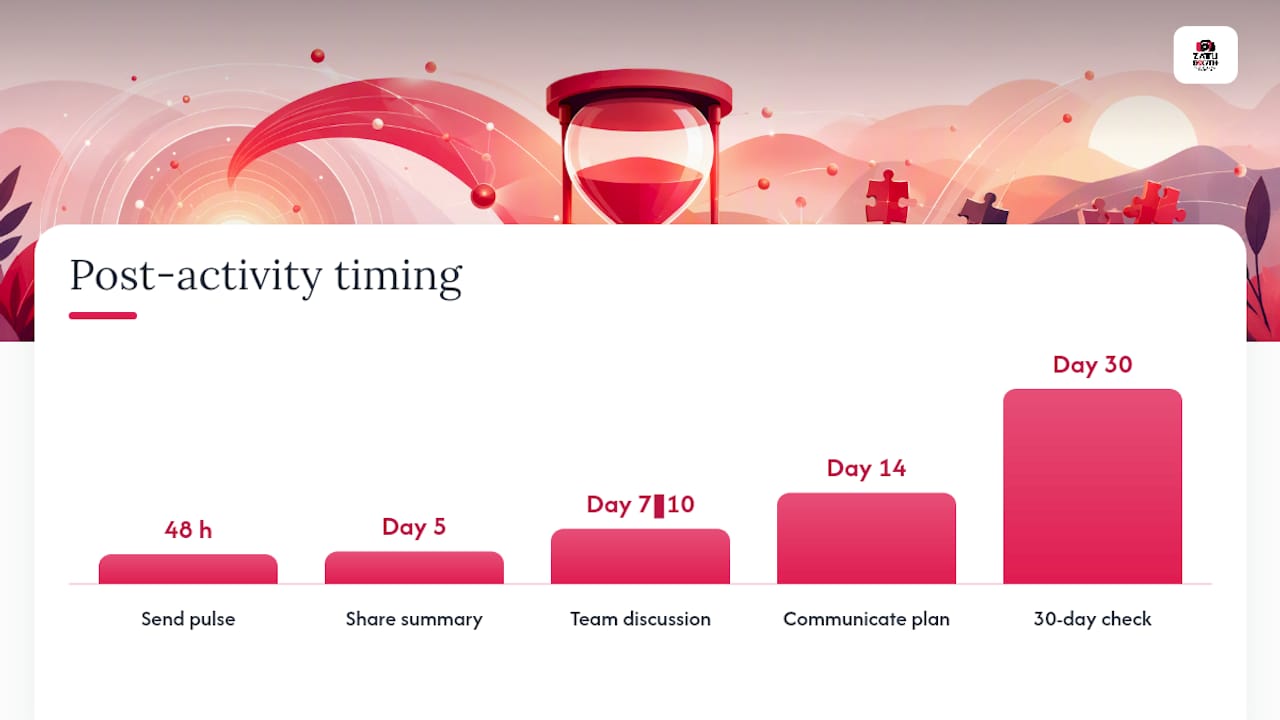
- Send a 2-question pulse within 48 hours of the activity.
- Compile results and share a one-page summary with the team by day 5.
- Hold a 20-minute team discussion to confirm themes (day 7–10).
- Select 1–2 priorities using the matrix; document the decision.
- Assign an owner and a deadline for each priority.
- Communicate the action plan to all employees by day 14.
- Check progress at the 30-day mark and share a brief update.
Sample pulse questions:
- “How connected did you feel to your team during today’s activity?” (1–5 scale)
- “Did this activity give you something useful or meaningful?” (Yes / Somewhat / No)
- “What would make the next one even better?” (open text, optional)
Pro Tip: Send pulses on Tuesday or Wednesday mornings for the highest response rates. Keep each pulse to 1–2 questions maximum — response rates drop sharply beyond that.
How do you choose which activities to run first?
Use an urgency-by-impact matrix to prioritise 2–3 quick wins and one strategic pilot, then write SMART objectives so you can measure whether they worked.
| Quadrant | Urgency | Impact | Action |
|---|---|---|---|
| Do first | High | High | Launch immediately (recognition rituals, pulse surveys) |
| Schedule | Low | High | Plan for next quarter (appreciation event, L&D programme) |
| Delegate | High | Low | Assign to a team lead (social channels, trivia) |
| Drop or defer | Low | Low | Remove from the plan for now |
Decision questions before you commit:
- Does this activity require budget approval, and how long does that take?
- Will it reach all employee demographics, including remote and part-time staff?
- Is there a leader willing to visibly champion it?
- Can you measure its effect with a pulse question?
SMART objective examples:
- Recognition: Increase the number of peer recognition mentions in our shared channel by 40% within four weeks of launching the shout-out ritual, measured by channel analytics.
- Connection: Achieve a 60% or higher positive pulse score on the “team connection” question after three consecutive monthly social check-ins.
- Event activation: Reach 75% employee participation at the Q3 staff appreciation event, measured by photo-station interactions and sign-in data.
A Canadian case study from Action Strategies found that targeted interventions, including recognition and career-pathing, produced substantial returns on modest investments, which makes the case for prioritising high-impact activities even when budgets are tight.
What does a 3-month rollout plan look like?
Start with a 3-month plan that balances quick wins in month one with a measurable pilot in month two and a review cycle in month three.
| Month | Milestone | Owner | Budget range | Notes |
|---|---|---|---|---|
| Month 1 | Launch recognition ritual + first pulse | HR lead + team managers | $0 | Use existing tools; no new spend required |
| Month 2 | Run micro-learning series + social check-ins; second pulse | L&D lead + team leads | $0 | Optional speaker budget; otherwise free |
| Month 3 | Host appreciation event or photo-activation; full pulse + review | HR lead + event vendor | $500 | Scale to team size; flat-rate booth pricing simplifies budgeting |
RACI snapshot:
- Responsible: HR lead (owns the plan and communications)
- Accountable: People & Culture director or equivalent senior leader
- Consulted: Team managers, employee resource group leads, finance
- Informed: All employees, executive team
Time estimate: roughly 2–3 hours per week for HR in months one and two, rising to 5–6 hours in month three around the event.
Tailoring for diverse teams: Survey employees on preferred activity formats before you launch. Introverts often prefer async or small-group formats; employees with caregiving responsibilities appreciate activities that fit within core hours. Offering both in-person and digital participation options for every activity is the single most inclusive design choice you can make.

How do you measure whether engagement is actually improving?
Track a short KPI set monthly: pulse scores, participation rate, event net promoter score, qualitative themes, and turnover signals. Weekly pulses work well for short pilots; monthly measures suit broader programmes.
Suggested KPIs:
- Pulse score trend: Average response on your connection or satisfaction question, tracked week over week.
- Participation rate: Percentage of eligible employees who joined each activity. Target 60%+ for optional activities.
- Event NPS: “Would you recommend this event to a colleague?” scored 0–10. Anything above 30 is a strong result.
- Qualitative themes: Tag open-text responses by theme each month and watch for shifts.
- Voluntary turnover rate: A lagging indicator, but meaningful over a 6–12 month window.
Dashboard suggestion: A single spreadsheet with one tab per KPI, updated monthly by the HR lead, shared with the leadership team in a standing monthly review.
Benchmark context: With Gallup placing Canadian engagement at 21%, even moving your team’s pulse score from 3.0 to 3.5 on a 5-point scale represents meaningful progress relative to the national baseline. Set realistic targets and celebrate incremental gains.
The lesson most HR teams learn the hard way
The single most important practitioner lesson is this: close the loop visibly, or the next activity will have lower participation than the last.
Do:
- Involve employees in choosing activities before you launch them.
- Keep participation optional; mandatory fun is the fastest way to generate resentment.
- Share pulse results with the team, even when the results are uncomfortable.
- Act on at least one piece of feedback before the next survey goes out.
Don’t:
- Run a one-off event and call it an engagement strategy.
- Survey without a plan to respond; HR Insider’s research is clear that this destroys credibility faster than not surveying at all.
- Assume the same activity works for every demographic or work arrangement.
- Wait for perfect conditions; a small, well-followed-up activity outperforms a large, forgotten one.
The activity itself was identical. The follow-up was not.
Make your next staff event genuinely memorable
Photo-activation is one of the most measurable, low-fuss additions to a staff appreciation day, awards night, or hybrid recognition event. Participation is visible in real time, keepsakes give employees something tangible to take home, and branded prints extend your recognition moment well beyond the event itself.
Three moments where a photo-activation adds clear value: a staff appreciation day where a roaming booth reaches every table without requiring guests to queue; a hybrid recognition event where digital sharing links bring remote employees into the moment; and a formal gala or awards night where a corporate photo booth rental with a customisable backdrop and studio-grade Nikon full-frame camera delivers red-carpet-ready photos that no tablet-based station can match. ZATTU PHOTO BOOTH operates on flat-rate pricing with owner-operators on-site, so there are no surprise costs and no subcontractors. To check availability for your next staff event, request a quote here.
Sources
The sources below are the most useful references cited in this article. Bookmark them for pulse design, psychological safety guidance, ROI evidence, and leadership research.
- How Best Workplaces™ across industry build employee engagement — Great Place To Work Canada
- How employers can manage employee retention, engagement during talent shortage — BenefitsCanada
- Using pulse surveys to engage your team — follow-up job aid | Canada School of Public Service (Ecole Canada)
- State of the Global Workplace — Canada country-level data | Gallup
- Authentic leadership and employee psychological safety: the mediating role of leader-member exchange — BMC Psychology (Springer Nature)