

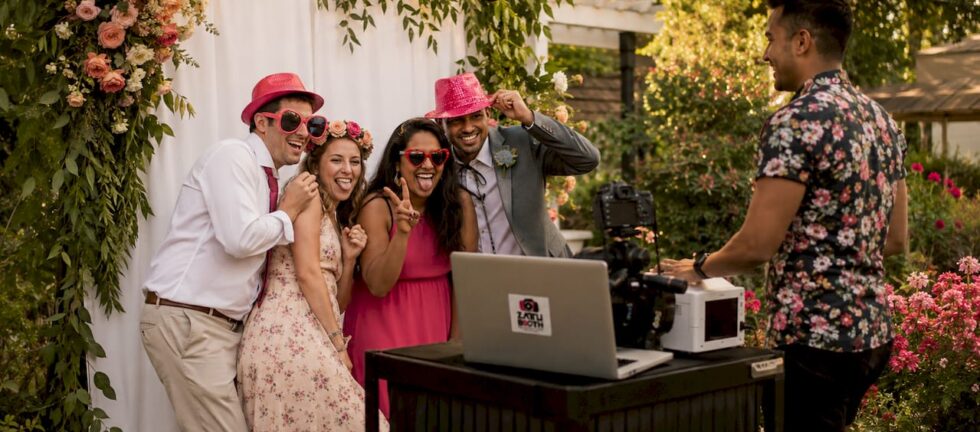
Professional photo booths are the superior choice for social events because they combine studio-grade cameras, professional lighting, and trained attendants to produce frame-worthy keepsakes that selfie stations simply cannot match. The gap between a Nikon full-frame mirrorless camera with studio strobes and a tablet propped on a stand is not subtle. It shows up in every print, every guest interaction, and every memory your guests take home. For weddings, milestone parties, and galas, that difference matters. Understanding why photo booths beat selfie stations helps you make a confident, informed decision before you book.
Why do professional photo booths beat selfie stations on image quality?
The single biggest advantage of a professional photo booth is camera quality. Professional booths use DSLR or mirrorless cameras with 24+ megapixels paired with studio strobes, while tablet-based selfie stations rely on front-facing cameras with lower megapixels that produce grainy, poorly lit results. A Nikon full-frame mirrorless sensor captures dramatically more light and detail than any tablet camera. That difference is visible even on a small 4×6 print.
Lighting is where professional booths truly separate themselves. Professional setups follow the inverse square law of light physics, positioning studio strobes at precise distances to produce even, flattering illumination across every guest’s face. Ring lights and tablet software flashes cannot replicate this. They create raccoon-eye shadows under brows, blown-out highlights on foreheads, and uneven skin tones that no filter can fully fix.
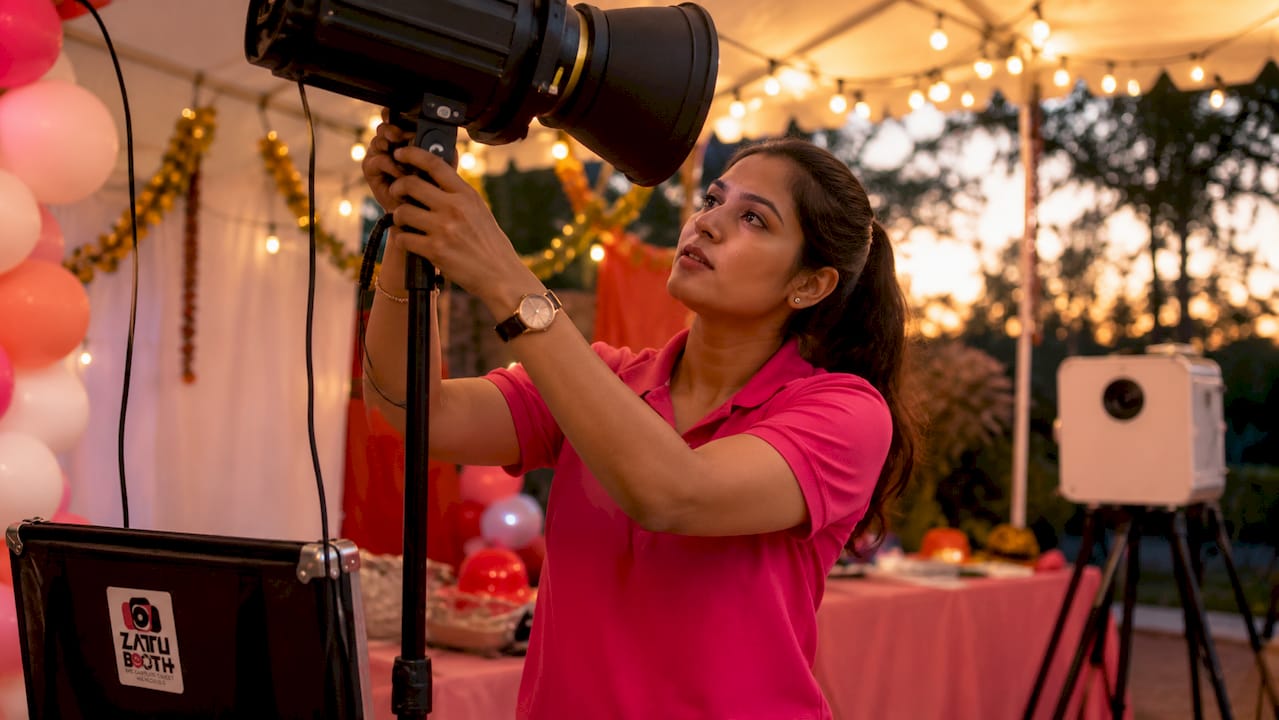
Print quality follows directly from camera quality. Professional booths use dye-sublimation printers, which fuse dye into the paper at a molecular level to produce water-resistant, fade-resistant prints. A dye-sublimation print from a professional booth looks sharp and vibrant years later. A screenshot shared from a selfie station looks fine on a phone screen but falls apart when printed at any meaningful size.
What does dye-sublimation printing actually mean for your guests?
Dye-sublimation printers produce a print in roughly 8–12 seconds per photo. That speed is fast enough to keep a queue moving while delivering a physical keepsake guests can hold, sign, and take home. Selfie stations deliver digital files instantly, but a file on a phone is easily forgotten. A physical print on the fridge or in a wedding album is not.
Pro Tip: Ask any photo booth vendor to show you a sample print before you book. A professional dye-sublimation print will feel smooth and slightly glossy, with no visible dot pattern. If you can see dots or feel texture, the printer is inkjet, not dye-sublimation.
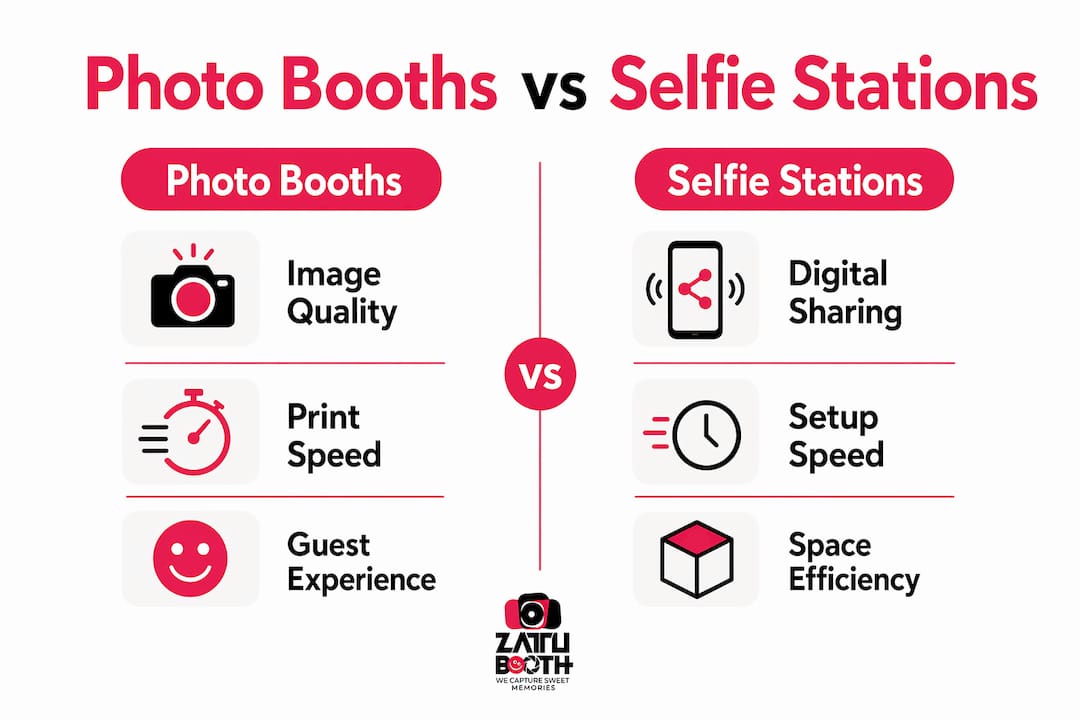
| Feature | Professional photo booth | Tablet selfie station |
|---|---|---|
| Camera sensor | Full-frame mirrorless, 24+ MP | Tablet front camera, lower MP |
| Lighting | Studio strobes, inverse square law | Ring light or software flash |
| Print output | Dye-sublimation, fade-resistant | Digital only or inkjet |
| Image quality in low light | Sharp and well-exposed | Grainy and uneven |
What experiential benefits do professional photo booths offer?
A professional photo booth is an experience, not just a feature. Guests behave and engage differently when a trained attendant is present and the booth creates a defined, slightly theatrical space. Attendants in professional booths increase usage by reducing guest self-consciousness, managing queues smoothly, and solving technical issues before they become problems. That human presence changes the energy around the booth entirely.
Enclosed or semi-enclosed booth designs also play a psychological role. Guests feel permission to be silly, dramatic, or affectionate inside a booth in a way they rarely do at an open selfie station in the middle of a reception hall. That enclosed feeling produces better, more natural photos and encourages repeat visits throughout the night.
Shy guests are a real consideration at any event. An open selfie station in a crowded room can feel exposed and awkward. A professional attendant who warmly invites guests over, hands them props, and counts them down removes that barrier. Technical issues like printer jams or Wi-Fi failures are handled immediately by the attendant, so you as the host never hear about them. You stay present at your own event.
- Attendants manage queues so no group waits more than a few minutes
- Props, backdrops, and posing guidance are provided on the spot
- Guests receive a physical print as a keepsake, not just a digital file
- Repeat visits are common when the experience feels welcoming and fun
- Hosts avoid all technical troubleshooting for the duration of the event
Pro Tip: Brief your photo booth attendant on two or three key guest groups before the event starts, such as grandparents, the wedding party, or the guest of honour. A good attendant will make sure those guests get to the booth and leave with a print.
In what event contexts are photo booths preferred over selfie stations?
The right choice depends on your event type, guest count, and what you want guests to walk away with. Professional photo booths are recommended for weddings and milestone events where emotional engagement and high-quality guest interaction are the priority. Selfie stations suit brand activations and trade shows where social media reach and digital data capture matter more than print keepsakes.
- Weddings and anniversary parties. Guests expect a premium experience. Physical prints double as event favours and become part of the couple’s memory archive. A professional booth with a custom backdrop and branded print overlay fits the occasion perfectly.
- Milestone birthday parties. A 50th or 70th birthday calls for something guests will actually keep. Dye-sublimation prints with the guest of honour’s name and date are tangible, lasting gifts.
- Corporate galas and award nights. These events benefit from the professionalism of an attended booth. Branded overlays reinforce the company’s identity, and guests associate the quality of the print with the quality of the event.
- Brand activations and trade shows. Here, speed and digital sharing take priority. A selfie station or a hybrid setup that delivers both a digital file and a branded print can serve a high-volume crowd efficiently.
- Community events and fundraisers. A professional booth with an attendant manages large, diverse crowds well. Professional booths can serve over 150 guests in three hours, making them practical for high-attendance events.
Hybrid event setups that combine a professional booth for premium prints with a digital sharing station for social media reach are growing in popularity in 2026. This approach gives you the best of both worlds without compromising on quality.
What practical considerations should you weigh before choosing?
Setup complexity is the first practical factor. A professional photo booth requires 30–60 minutes of setup time and a dedicated power source. A tablet selfie station can be assembled in under 10 minutes. If your venue has limited setup time or restricted access, that gap matters.
Cost is the second factor. Professional photo booth rentals typically cost between $475 and $1,500+ and include attendants, studio lighting, and instant prints. Tablet-based or DIY setups range from $100 to $500 but require the host or a volunteer to manage them. The lower price of a DIY setup often comes with hidden costs in time, stress, and guest experience.
Throughput is the third factor. 360 photo booths process 40–80 guests per hour, while tablet selfie stations can handle 60–90 sessions per hour but cannot produce print-ready, high-resolution images at that speed. If your guest list exceeds 150 people and you want physical prints, plan for a professional booth with a fast dye-sublimation printer and a well-managed queue.
- Guest volume under 75: A selfie station or hybrid setup may be sufficient
- Guest volume 75–150: A professional booth with one attendant handles this comfortably
- Guest volume over 150: Consider two booths or a hybrid setup with a dedicated attendant at each
- Print keepsakes required: Professional booth with dye-sublimation printer is the only reliable option
- Digital sharing priority: A selfie station or hybrid setup delivers faster social media results
Pro Tip: Ask your venue coordinator for the exact setup window before comparing booth options. A 30-minute setup window rules out most professional booth configurations unless the vendor has pre-staged equipment.
Key takeaways
Professional photo booths consistently outperform selfie stations in image quality, guest experience, and lasting keepsakes because they combine full-frame cameras, studio lighting, dye-sublimation printing, and trained attendants.
| Point | Details |
|---|---|
| Camera and lighting quality | Full-frame mirrorless cameras with studio strobes produce sharp, flattering photos that tablet cameras cannot match. |
| Dye-sublimation prints | Physical prints from professional booths are fade-resistant and far more memorable than digital-only sharing. |
| Attendant impact | A trained attendant increases guest participation, manages queues, and handles all technical issues on the spot. |
| Event type fit | Weddings and milestone events favour professional booths; brand activations may suit hybrid or digital setups. |
| Cost versus value | Professional rentals cost more upfront but include equipment, expertise, and prints that DIY setups cannot replicate. |
Why I believe professional booths are still the gold standard
George ZATTU here. After years of running photo booths at weddings, galas, and corporate events across Southwestern Ontario, the question I hear most often is whether a tablet selfie station is “good enough.” My honest answer is: good enough for what?
If you want guests to grab a quick digital photo and post it, a selfie station works. But if you want guests to gather, laugh, hold a print in their hands, and feel like the event invested in them, a professional booth is not optional. I have watched guests at weddings spend 20 minutes at our booth, cycling through three or four groups, because the experience felt worth repeating. I have never seen that happen at an open tablet station.
The misconception I see most often is that the camera is the only difference. Lighting is equally important, and it is the hardest thing to replicate without professional equipment. A ring light flattens faces and creates harsh shadows. Studio strobes shaped and positioned correctly make every guest look genuinely good. That is not a small thing when someone is going to frame that photo.
My recommendation for 2026 is to think about what you want guests to feel, not just what you want them to receive. A physical print is a trigger for memory in a way that a phone notification is not. If your event is worth celebrating, it is worth capturing properly.
— George ZATTU
ZATTU PHOTO BOOTH: professional photo booths for your next event
Planning a wedding, gala, or milestone party in Southwestern Ontario? ZATTU PHOTO BOOTH brings studio-grade equipment, trained attendants, and instant dye-sublimation prints to every event we serve.
Our packages include Nikon full-frame mirrorless cameras, professional studio lighting, custom print overlays, and a dedicated attendant who manages everything from setup to the last print of the night. You bring the guests. We handle the rest. Request a quote and find out which booth style fits your event best. From mirror booths to glam setups to AI-powered experiences, we have an option for every occasion and every guest list size.
FAQ
Are photo booths better than selfie stations for weddings?
Professional photo booths are the better choice for weddings because they produce high-resolution prints, provide an attended experience, and create physical keepsakes guests keep long after the event.
Why do professional photo booths beat tablets on image quality?
Professional booths use full-frame mirrorless cameras with 24+ megapixels and studio strobes, while tablet selfie stations rely on lower-resolution front cameras and ring lights that produce grainy, unevenly lit photos.
How many guests can a professional photo booth serve?
Professional booths can serve over 150 guests in three hours with a trained attendant managing the queue and a dye-sublimation printer producing prints in 8–12 seconds each.
What is the main advantage of dye-sublimation printing?
Dye-sublimation prints are water-resistant, fade-resistant, and sharp at full print size, making them far more durable and display-worthy than inkjet or digital-only outputs from selfie stations.
When does a selfie station make more sense than a photo booth?
Selfie stations suit brand activations and trade shows where digital data capture and fast social media sharing matter more than physical print keepsakes or premium guest experience.