

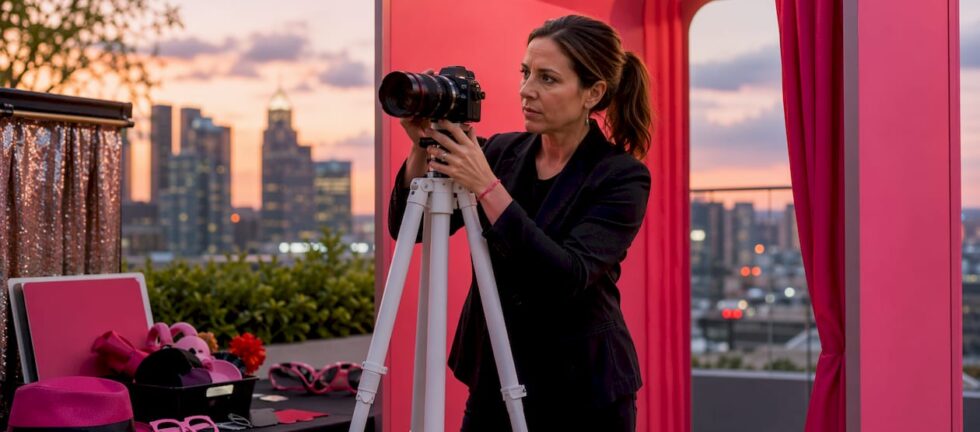
For galas, awards nights, and premium brand activations, studio-grade photo booths deliver the consistent image quality, controlled privacy, and branded output that high-profile events demand. When the guest list includes VIPs, sponsors, or media, a tablet-based selfie station simply cannot carry the weight. The output looks amateur, the experience feels transactional, and the photos rarely survive the trip to social media in any meaningful way.
Here is the short version you can read aloud to a client:
- Brand perception: Premium booth rentals with studio-grade lighting and professional optics signal that quality was prioritised, not just the budget.
- Consistent technical output: Full-frame or APS-C mirrorless cameras with strobes produce the same result for guest one and guest two hundred.
- Privacy and editorial control: Enclosed setups keep backgrounds clean and protect VIP guests from ambient crowd shots.
- Social shareability: Polished, well-lit images travel further on social platforms and carry sponsor branding with them.
- ROI via branded assets: Every printed keepsake and digital share extends the event’s reach well beyond the room.
ZATTU PHOTO BOOTH is a Southwestern Ontario provider that operates exactly this way: Nikon full-frame mirrorless cameras, professional lighting, and a trained attendant at every activation.
Table of Contents
- Why the equipment you book changes everything for premium events
- What actually separates studio-grade from consumer booths
- Which booth style fits which high-profile moment
- How a premium booth turns guests into active participants
- Practical logistics every planner needs to confirm
- How to evaluate a studio-grade booth vendor before you sign
- How ZATTU PHOTO BOOTH delivers studio-grade standards in Southwestern Ontario
- When to book a studio-grade booth in Canada: lead times that matter
- Contractual considerations and cancellation policies for photo booth hire
- Key takeaways
- When a studio-grade booth is worth every dollar, and when it is not
- ZATTU PHOTO BOOTH is ready for your next high-profile event
- Useful sources for planners
Why the equipment you book changes everything for premium events
The difference between a studio-grade booth and a consumer setup shows up immediately in the photos, and your stakeholders will notice. At a corporate awards night, the CEO’s portrait needs to look like it belongs in the annual report, not a birthday party album. At a charity gala, donors expect an experience that matches the ticket price. A polished aesthetic correlates directly with higher brand perception and shareability, which means the booth is doing real marketing work, not just providing entertainment.
For sponsors, the calculus is straightforward: their logo appears on every print and every digital share. If the image quality is poor, the association hurts rather than helps. For VIP guests, the experience itself is the signal. An attendant-directed session in a well-lit, enclosed booth feels like a private photoshoot. A self-serve iPad station feels like a queue at a shopping mall.
Statistic callout: Investing in studio-grade equipment acts as a brand signal that organisers prioritised quality, and that signal travels with every image shared online.
Pro Tip: Position the booth near the event’s signature design element, whether that is a floral installation, a branded step-and-repeat, or an architectural feature. Editorial shots that echo the event’s visual identity perform better on social media and give sponsors a richer content asset.
What actually separates studio-grade from consumer booths
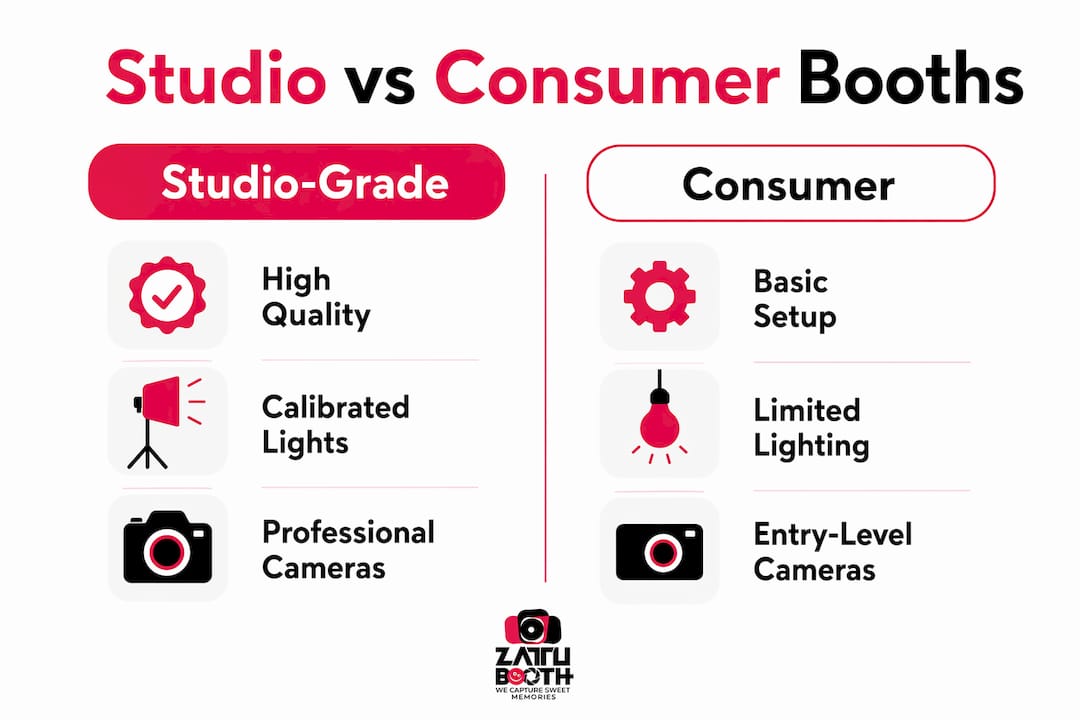
The gap is not just about having a nicer camera. It is about the entire capture pipeline, from light source to final print. DSLR and mirrorless sensors with strobes or soft-box lighting are the standard that seasoned organisers specify, and for good reason: they eliminate digital noise, preserve skin tones under ballroom lighting, and produce consistent colour balance across hundreds of sessions.
The five differences that materially affect results:
- Lighting source: Professional strobes or soft boxes versus LED ring lights. Strobes freeze motion and wrap light evenly; ring lights create flat, circular catchlights and struggle with groups.
- Camera sensor: Full-frame or APS-C mirrorless versus tablet camera. Sensor size determines dynamic range and low-light performance, both critical in dim ballroom settings.
- Lens quality: Fast prime or zoom lenses (typically 35mm–85mm equivalent) versus fixed-focal tablet glass. Proper optics render backgrounds cleanly and flatter subjects.
- Colour calibration: Manual white balance set to the venue’s lighting versus auto-white-balance on a tablet, which drifts between guests.
- Print pipeline: Dye-sublimation printers on quality stock versus inkjet or no print at all. Dye-sub prints are water-resistant, archive-quality, and dry instantly.
| Dimension | Studio-grade setup | Consumer/tablet setup |
|---|---|---|
| Image quality | High resolution, low noise, accurate colour | Variable, often noisy in low light |
| Lighting control | Calibrated strobes or soft boxes | Ring light or ambient only |
| Privacy | Enclosed or controlled backdrop | Open, ambient background |
| Repeatability | Consistent across all guests | Varies with ambient conditions |
| Brand customisation | Overlays, prints, exterior wraps | Basic digital overlay only |
| Print quality | Dye-sublimation, archive-grade | Inkjet or digital-only |
Equipment planners should expect in a studio-grade package:
- Mirrorless or DSLR body (full-frame or APS-C) with manual exposure control
- Professional strobe or soft-box lighting with colour-temperature calibration
- Fast prime or zoom lens appropriate to the booth footprint
- Dye-sublimation printer with branded print templates
- Tethered or wireless capture software with live preview
- Backup power supply or UPS for the printer and camera system
- Secure digital gallery with same-night or next-day delivery
Pro Tip: Ask your vendor specifically about lighting modifiers and colour temperature. A bare strobe without a diffuser creates harsh shadows on faces. A soft box or beauty dish at the correct colour temperature (typically 5,500K) is what produces that clean, editorial look.
Which booth style fits which high-profile moment
Not every format suits every moment, and choosing the wrong style for a VIP setting is a fast way to underdeliver. Enclosed studio booths are the preferred premium activation for high-profile events precisely because they combine privacy, editorial control, and a branded environment in one unit.
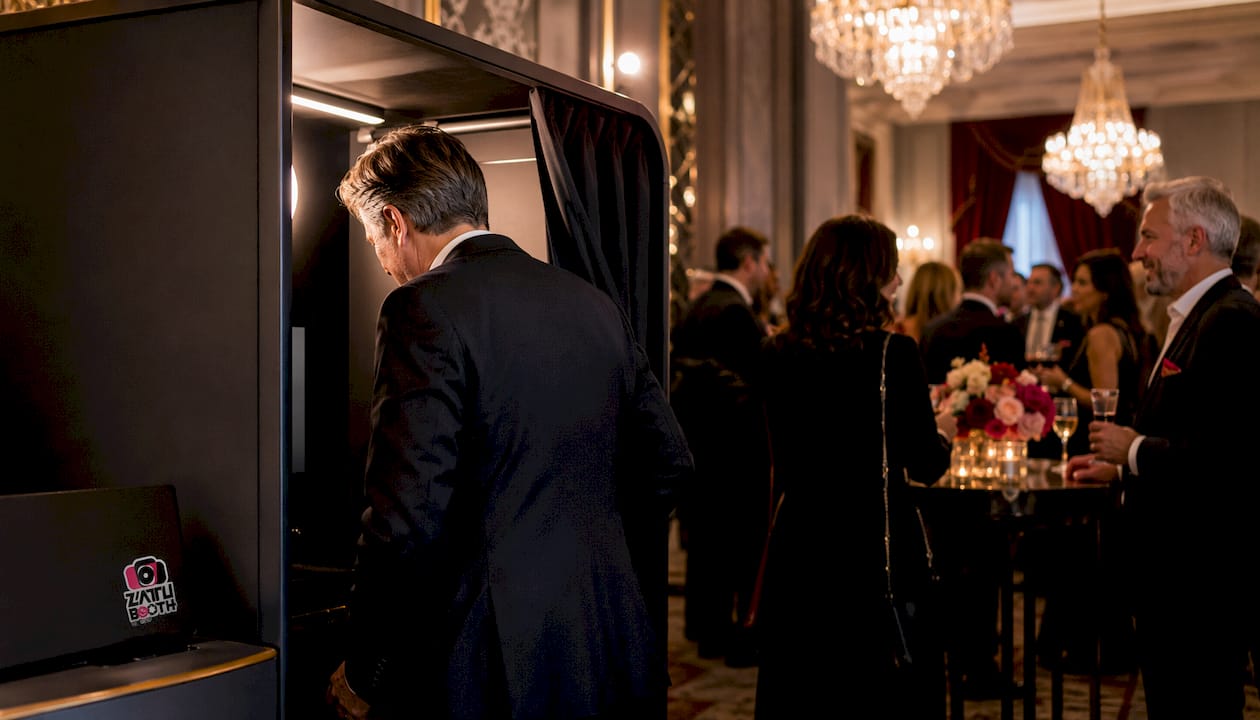
Enclosed/studio booth: The top choice for galas, awards nights, and VIP receptions. Guests step inside a controlled environment, away from ambient crowd noise and background clutter. The result is a consistent, editorial-quality image every time. Luxury enclosed booths can command premium price points for high-end activations, and the market is moving firmly in this direction.
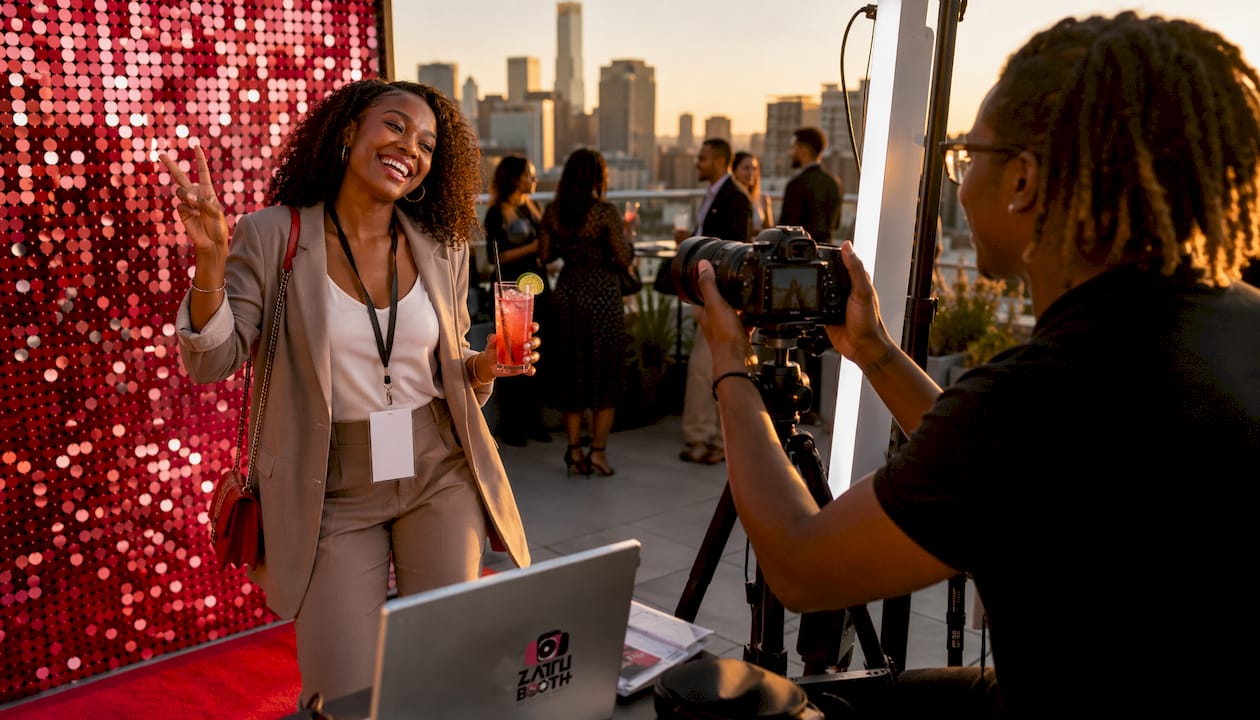
Open-air with backdrop: Works well for cocktail receptions and activation floors where throughput matters more than privacy. The trade-off is ambient light interference and less control over the background. Acceptable for general-admission areas when paired with professional lighting rigs.
360-degree rig: Best deployed as a secondary activation at product launches or brand moments where video content is the goal. Generates strong social content but requires significant floor space (typically 12–15 feet in diameter) and a longer guest session time.
Mirror booth: A strong choice for weddings and galas where the aesthetic is part of the experience. The full-length mirror format encourages full-body shots and styling, which suits fashion-forward events. Pairs well with a red-carpet moment.
Roaming booth/photographer: Ideal for cocktail hours and networking events where guests are moving. A roaming operator captures candid, editorial-style moments that a fixed booth cannot. Works best as a complement to a fixed studio setup, not a replacement.
Use-case mapping:
- Red carpet arrival: enclosed studio booth or mirror booth
- VIP lounge: enclosed studio booth with attendant
- Cocktail reception: open-air with professional lighting or roaming operator
- Activation floor: 360-degree rig or open-air with branded backdrop
- Post-event social hub: enclosed booth with instant digital sharing station
Capacity and flow note:
- Enclosed booths typically accommodate a small group of guests per session, with sessions running a few minutes including printing.
- For events with several hundred guests, plan for multiple hours of active booth time to give everyone a session without queuing frustration.
- For larger events, consider a second booth or a roaming operator to manage flow during peak periods.
- Schedule VIP slots in the first 30–45 minutes before general access opens to preserve the exclusive feel.
How a premium booth turns guests into active participants
A studio-grade booth does not just sit in the corner waiting to be used. When it is set up correctly and staffed by a skilled attendant, it becomes the most talked-about activation in the room. Attendant direction converts a passive booth into an interactive, runway-inspired photoshoot that improves guest retention and generates content guests actually want to share.
The activation levers that make the difference:
- Attendant direction: A trained operator guides poses, adjusts lighting for each group, and ensures every shot is frame-worthy before the guest leaves.
- Curated props and styling: High-quality, on-brand props that match the event aesthetic rather than generic plastic accessories.
- Branded overlays and prints: Custom templates that carry the event name, sponsor logo, or campaign hashtag on every deliverable.
- Instant digital sharing stations: A dedicated screen or kiosk where guests can text or email their photos immediately, driving real-time social posting.
- Dual deliverables: A physical print to take home and a digital file for sharing. Both extend the event’s reach in different ways.
For corporate activations, enclosed booths double as branding real estate: exterior wraps, branded overlays, and secondary screens showing sponsor content turn the booth itself into an impression-generating asset. Pair the booth with a live social media feed displaying tagged posts, and you create a feedback loop that encourages more guests to participate.
Pairing a premium photo booth with custom cocktail activations is one of the most effective ways to anchor a high-end corporate event around two memorable, shareable moments.
Pro Tip: Reserve the first 30–45 minutes exclusively for VIP guests with a dedicated attendant. A branded waiting area with a simple seating arrangement and the event’s visual identity on display makes the queue feel like part of the experience, not a delay.
Practical logistics every planner needs to confirm
Studio-grade booths are hard assets in your run-of-show, not plug-and-play gadgets. Treat them with the same planning rigour as main production elements: power redundancy, reserved loading windows, and security considerations all apply.
Minimum site requirements:
- Footprint: enclosed booths typically require a moderate footprint; open-air setups need somewhat larger space with backdrop.
- Power: a dedicated circuit is standard; avoid sharing with catering equipment or DJ rigs.
- Ceiling height: sufficient vertical clearance is needed for enclosed units and mirror booths.
- Loading access: confirm elevator dimensions and loading dock availability for enclosed units, which can be moderately heavy.
Run-of-show integration checklist:
- Confirm load-in window with venue: typically 2–3 hours before doors open for enclosed setups.
- Schedule a tech rehearsal: 30 minutes to test lighting, print output, and digital sharing links.
- Confirm attendant arrival time: 60 minutes before guest access to complete setup and test prints.
- Identify a downtime contingency: who does the attendant call, and what is the backup plan if a printer jams?
- Confirm data security: who owns the guest photos, and how are they stored and deleted post-event?
- Reserve a secure storage area for print stock, props, and equipment cases during the event.
Typical cost components for a premium booth package:
| Cost component | What it covers |
|---|---|
| Equipment rental | Camera, lighting, booth structure, printer |
| Attendant (per hour) | Setup, direction, troubleshooting, pack-down |
| Prints | Dye-sublimation stock, branded templates |
| Setup and takedown | Labour for load-in and strike |
| Travel | Mileage or transport for Southwestern Ontario events |
| Insurance | Liability coverage for equipment and guests |
| Digital gallery | Hosting, delivery, and access window |
Typical on-site timeline:
| Phase | Duration | (Typical durations are provided; exact times vary by event)
|—|—|
| Load-in and setup | Several hours before doors |
| Tech rehearsal | Brief testing period |
| VIP access window | Initial segment of event |
| General guest access | Main chunk of event |
| Pack-down and strike | Post-event teardown period |
How to evaluate a studio-grade booth vendor before you sign
The five supplier attributes that predict a successful activation are: verified gear, experienced staff, a strong portfolio, clear insurance, and specific deliverables with a defined turnaround. Any vendor who cannot answer directly on all five deserves more scrutiny before you commit.
Questions to ask every vendor:
- What is the exact camera model and sensor size you will bring to this event?
- What lighting system do you use, and how do you handle venue lighting conditions?
- What printer model and media stock do you use for prints?
- What is your backup plan if the printer fails mid-event?
- Who owns the guest photos, and how long do you retain them after the event?
- Can you share sample deliverables from a comparable event (gala, awards night, corporate activation)?
- What is the turnaround time for the digital gallery after the event?
- Are you insured for liability, and can you provide a certificate of insurance to the venue?
Reviewing a vendor’s professional photo booth camera specs before your first meeting puts you in a much stronger position to evaluate their answers.
Red flags that should trigger more due diligence:
- No equipment list or vague answers about camera model (“we use professional equipment”)
- No liability insurance or unwillingness to provide a certificate
- Deliverables described as “photos on a USB” with no gallery or turnaround commitment
- Hidden fees for setup, travel, or additional print runs not disclosed upfront
- No portfolio from comparable events or only low-resolution samples
Contract checklist:
- Specific deliverables listed: print count, digital gallery, turnaround time
- Cancellation and force majeure terms: deposit structure, rebooking policy, weather/venue clauses
- Liability limits: equipment damage, guest data, third-party claims
- Data ownership and deletion timeline for guest images
- Overtime rate if the event runs long
How ZATTU PHOTO BOOTH delivers studio-grade standards in Southwestern Ontario
ZATTU PHOTO BOOTH brings full studio-grade production to corporate galas, weddings, charity events, and brand activations across Kitchener-Waterloo, Guelph, Hamilton, and the broader Southwestern Ontario region. Every activation is owner-operated, which means the person who quoted your event is the person running it on the night.
Equipment and service summary:
- Nikon full-frame mirrorless camera with manual exposure control
- Professional lighting with calibrated colour temperature for ballroom and venue conditions
- Booth types available: studio booth, mirror, glam, AI-powered, roaming, and self-serve iPad station
- Dye-sublimation printing with fully branded templates
- Instant digital sharing with same-night gallery access
- Flat-rate pricing with all inclusions stated upfront: no hidden fees for setup, travel within the service area, or standard print runs
What planners consistently highlight:
- Prompt communication from first enquiry through to post-event gallery delivery
- Willingness to review the venue layout and run-of-show in advance
- Consistent output quality across the full guest list, not just the first hour
- Portfolio access from comparable events available on request
ZATTU PHOTO BOOTH’s flat-rate model means your client brief can include a firm number from day one. No per-print surprises, no overtime ambiguity. For planners who need to present a clean budget to a board or sponsor, that clarity is worth as much as the equipment itself.
When to book a studio-grade booth in Canada: lead times that matter
High-profile events in Canada, particularly in urban and suburban markets like Kitchener-Waterloo, Toronto, Hamilton, and Guelph, follow a predictable booking calendar. Studio-grade providers with full equipment inventories and trained staff book out faster than commodity suppliers, and the gap widens significantly during peak season.
Typical lead times by event type:
- Corporate galas and awards nights (October–December): book 3–5 months in advance; Q4 is the most competitive window.
- Weddings (May–October): book 6–12 months in advance for Saturday dates; Friday and Sunday dates have more flexibility at 3–4 months.
- Charity galas and fundraisers (spring and fall): book 2–4 months in advance, though high-profile events with complex branding requirements benefit from 4–6 months.
- Product launches and brand activations: book 4–8 weeks in advance for straightforward setups; custom branding, exterior wraps, and bespoke overlays require 6–10 weeks minimum for production.
The practical rule: if your event date is fixed and the guest count exceeds 150, start vendor conversations the moment the date is confirmed. Waiting until 4–6 weeks out for a December gala in Southwestern Ontario almost guarantees your first-choice provider is unavailable.
What the booking process typically involves:
- Initial enquiry and date check (same day to 48 hours for most reputable providers)
- Consultation call to confirm event details, booth type, branding requirements, and logistics
- Proposal and contract issued (typically within 3–5 business days)
- Deposit paid to secure the date (typically 25–50% of total package cost)
- Branding and design approval (2–4 weeks before the event for print templates and overlays)
- Final confirmation call 1–2 weeks before the event to review run-of-show
Booking early also gives you leverage on branding customisation. Providers who are not under time pressure will invest more in getting your templates exactly right.
Contractual considerations and cancellation policies for photo booth hire
A photo booth contract for a high-profile event is a service agreement, not a casual booking confirmation. The terms you agree to upfront determine your exposure if the event is postponed, cancelled, or if the vendor underdelivers.
Key contractual terms to review before signing:
Deposit and payment schedule. Most studio-grade providers require a non-refundable deposit of 25–50% to hold the date, with the balance due 7–30 days before the event. Confirm whether the deposit is transferable to a new date if you need to reschedule.
Cancellation terms. A standard tiered structure looks like this: full deposit forfeited for cancellations within 90 days; 50–75% of total contract value forfeited within 30 days; full contract value forfeited within 14 days. These terms vary by provider, so read them carefully and negotiate before signing, not after.
Force majeure clause. Confirm that the contract addresses venue closure, government-ordered event restrictions, and extreme weather. A well-drafted clause should allow for rebooking within a defined window (typically 12 months) without penalty when the cancellation is outside both parties’ control.
Deliverables and turnaround. The contract should specify: the number of prints included, the digital gallery delivery timeline (same night, 24 hours, 48 hours), the file format and resolution, and the duration of gallery hosting. Vague language like “photos delivered after the event” is a red flag.
Liability and insurance. Confirm the provider carries general liability insurance and that the certificate names your venue if required. Understand the limits: most reputable providers carry $2M–$5M in general liability coverage, though this varies. Equipment damage caused by guests is typically the client’s responsibility under most contracts, so clarify this before signing.
Data ownership and privacy. Particularly relevant for corporate events: confirm who owns the guest images, how long the provider retains them, and whether they can be used in the provider’s marketing materials. Many corporate clients require a data-use restriction clause.
Pro Tip: Ask for a sample contract before you commit to a consultation. A provider who shares their standard terms openly is demonstrating the kind of transparency that holds up under pressure on event day.
Key takeaways
Studio-grade photo booths are the right choice for high-profile events because they deliver consistent, editorial-quality output that protects brand perception, satisfies VIP guests, and generates shareable branded content that extends the event’s reach.
| Point | Details |
|---|---|
| Equipment drives outcomes | Full-frame mirrorless cameras, calibrated strobes, and dye-sub printing produce results that tablet booths cannot match. |
| Enclosed booths lead for VIP settings | Privacy, editorial control, and branding real estate make enclosed formats the standard for galas and awards nights. |
| Book early in Canada | Corporate Q4 dates and peak wedding season require 3–12 months of lead time with studio-grade providers. |
| Contracts protect both parties | Confirm deposit terms, force majeure, deliverables, and data ownership before signing any agreement. |
| ZATTU PHOTO BOOTH | Owner-operated, Nikon full-frame mirrorless, flat-rate pricing, serving Kitchener-Waterloo, Guelph, Hamilton, and Southwestern Ontario. |
When a studio-grade booth is worth every dollar, and when it is not
The honest answer is that studio-grade is not always necessary. A casual staff appreciation party with 50 people and no sponsor obligations does not need a $2,500 enclosed booth. But the moment any of these three conditions apply, a consumer-grade setup becomes a liability rather than a saving.
Three scenarios where studio-grade is non-negotiable:
- VIP guest list. When your attendees include executives, donors, dignitaries, or media, the experience they have at the booth reflects directly on the host. A poor-quality image shared by a VIP does more reputational damage than no booth at all.
- Brand activation with shareable assets as a deliverable. If a sponsor is paying for impressions, or if the event’s success is measured in social reach, the image quality determines the ROI. Blurry, poorly lit photos do not get shared.
- Events where photography is the primary keepsake. Galas, weddings, and awards nights where guests expect to take something home require print quality that holds up on a mantelpiece, not just a phone screen.
What happens when planners choose a cheaper format for these scenarios:
- Brand perception drops when VIP photos circulate with visible noise, flat lighting, or generic backgrounds.
- Sponsor logos on low-quality prints look unprofessional and reduce the likelihood of renewal.
- Guests who expected a premium experience remember the disappointment, not the savings.
A simple decision rule for scoping meetings: multiply the event’s audience size by its brand stakes by the budget available. When two of those three factors are high, studio-grade is the right call. When all three are low, a simpler format is perfectly appropriate.
Pro Tip: For large events with mixed audiences, pair a studio booth in the VIP lounge with a self-serve selfie station for the general floor. You protect the premium experience for the guests who matter most to your client while managing overall costs.
ZATTU PHOTO BOOTH is ready for your next high-profile event
When you need a studio-grade activation that shows up prepared, performs consistently, and delivers frame-worthy keepsakes your clients will talk about, ZATTU PHOTO BOOTH is the local answer for Southwestern Ontario.
We bring Nikon full-frame mirrorless cameras, professional lighting, and a trained attendant to every event, with flat-rate pricing that includes setup, takedown, branded prints, and same-night digital gallery access. No subcontractors, no surprises on the invoice. Whether you are planning a corporate gala in Kitchener-Waterloo, a charity fundraiser in Guelph, or an awards night in Hamilton, our studio photo booth packages are built for exactly the standard your event requires. We also offer corporate booth rental options tailored to brand activations and sponsor-driven events.
Ready to lock in your date? Request a quote and we will confirm availability and send a detailed proposal within one business day.
Useful sources for planners
These sources informed the research and analysis in this article. Each is worth bookmarking for ongoing vendor evaluation and trend tracking.
- Benefits of premium booth rentals for event organizers — Practical overview of why studio-grade equipment acts as a brand signal at high-profile events; useful for client briefing conversations.
- Why enclosed photo booths are the top 2026 brand activation trend — Covers the luxury-versus-commodity split in the event industry and the return of enclosed booths as the premium activation standard.
- What matters in a professional photo booth — Technical breakdown of camera sensors, lighting chains, and print pipelines; the best reference for evaluating vendor equipment claims.
- Enclosed photo booth for VIP and gala events — Real-event examples of enclosed booths at celebrity and gala activations; useful for setting client expectations on VIP experience.
- Magazine photo booth hire: what it is and why it stands out — Explains the attendant-directed, editorial-style booth model and why it drives dwell time and repeat sessions.
- Environmental control and professional results — Explains why isolating the booth from ambient light and noise is the key difference between amateur and professional output.
- ZATTU PHOTO BOOTH studio booth service page — Full equipment list, booth types, and package details for Southwestern Ontario events; the fastest way to confirm availability and scope.
- Professional photo booth camera: what matters — Technical deep dive on camera and lighting specifications; recommended reading before your first vendor evaluation call.
- How professional bartending can transform your event — Partner content on pairing premium F&B activations with high-end event experiences; useful for planners building multi-activation programmes.