

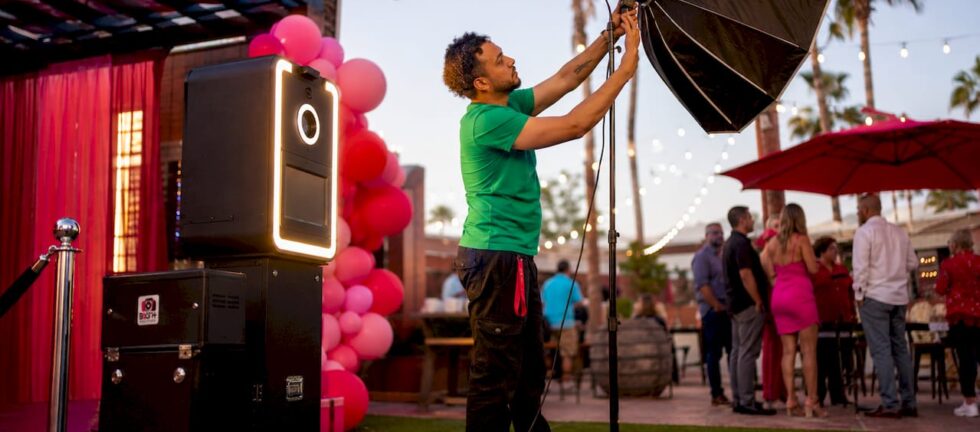
Photo quality in photo booths is defined by three core variables: lighting quality, camera sensor technology, and how well the equipment is integrated as a complete system. Understanding why photo quality varies across photo booths matters because the gap between a blurry, flat snapshot and a frame-worthy keepsake is not accidental. It is the direct result of deliberate equipment choices. ZATTU PHOTO BOOTH builds every setup around Nikon full-frame mirrorless cameras, professional-grade lighting, and studio-tested configurations precisely because these factors determine whether guests walk away with photos they actually want to share.
Why photo quality varies across photo booths: lighting is the biggest factor
Lighting quality is the primary driver of photo booth image quality, and professional-grade LEDs with a Colour Rendering Index (CRI) of 90 or above are the standard for natural skin tones. Standard RGB LEDs commonly used in budget booths often fall below 50 CRI. That gap is visible in every photo: colours look muddy, skin tones shift orange or green, and shadows fall in the wrong places.
The CRI scale measures how accurately a light source renders colour compared to natural daylight. A CRI of 90 means the light reproduces colour at 90% fidelity to sunlight. At 50 CRI, a red dress can photograph as brown and a warm complexion can look sallow. For event planners, this is the single most important specification to ask about when evaluating any photo booth rental.
Lighting design impacts image quality more than camera body specs in photo booth environments. Uneven, flat, or colour-cast lighting ruins photos even when paired with a high-end camera. This is a counterintuitive truth that most event planners never hear from budget rental providers.
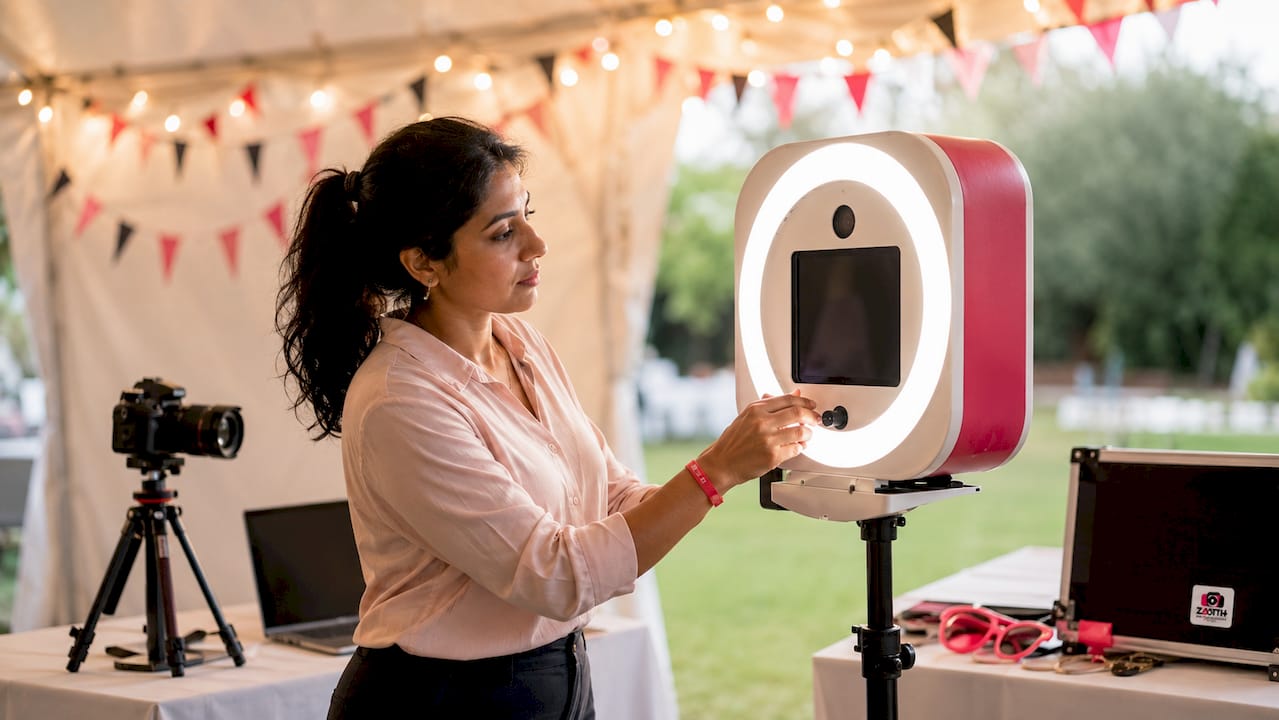
Mixed lighting creates a specific problem called a colour cast. Multiple light sources at 4000K and 6000K cause the camera to misjudge white balance, leaving one side of the photo appearing orange and the other appearing blue. Venues with warm ambient chandeliers, cool fluorescent overheads, and coloured uplighting are especially prone to this issue.
Pro Tip: Ask your photo booth provider for the CRI rating of their lighting. Any professional provider should answer immediately. If they cannot, that tells you everything about their setup.
Good lighting also gives the camera flexibility with exposure settings. With insufficient light, cameras increase ISO to compensate, which introduces grain and reduces sharpness. Professional lighting keeps ISO low and images clean.
- High CRI (90+) LEDs reproduce accurate skin tones and vibrant colours
- Low CRI (below 50) LEDs produce muddy, inaccurate colour in every photo
- Mixed colour temperatures create visible colour casts across the frame
- Insufficient light forces cameras into high ISO, causing grain and blur
- Adaptable lighting rigs maintain consistency as venue ambient conditions change
How camera technology affects photo booth image quality
Camera sensor size and resolution are the second major reason why photo booth images differ so dramatically between providers. DSLR and mirrorless camera rigs outperform tablet-based booths in low-light venues because of larger sensors and proper flash integration. Tablets use a screen flash and a small sensor that limits dynamic range. A Nikon full-frame mirrorless sensor captures significantly more light per pixel, which translates directly into sharper, cleaner images.
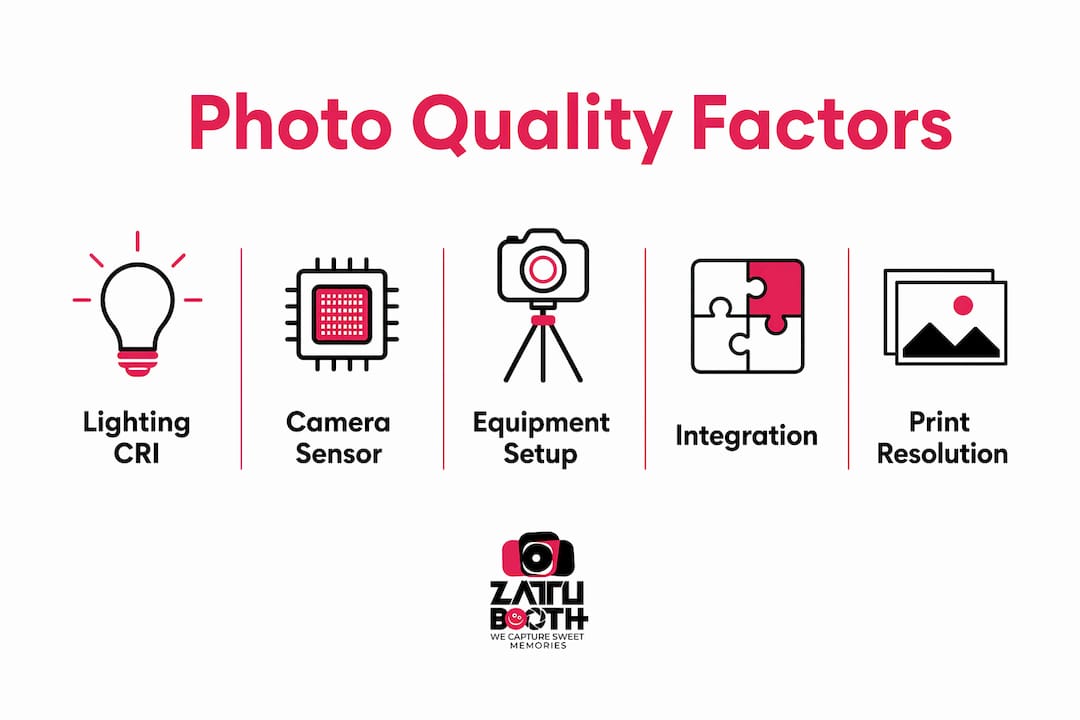
Resolution matters for print quality. At least 20 megapixels is the recommended minimum for professional prints, allowing room for cropping and retouching without losing sharpness. Professional cameras in the 24–45 megapixel range produce files large enough for high-quality prints at any standard event size. Tablet cameras rarely reach this threshold with the same image fidelity.
The common misconception is that megapixels alone determine quality. They do not. A 45-megapixel image captured on a small sensor in poor lighting will look worse than a 24-megapixel image from a full-frame sensor with proper illumination. Sensor size determines how much light each pixel captures. More light per pixel means less noise, better colour depth, and sharper detail in every condition.
Pro Tip: When comparing photo booth options, ask for sample prints from the actual equipment, not marketing photos. Real output from the rig tells you far more than a spec sheet.
For event planners choosing between camera system options, the practical question is not “DSLR or tablet?” It is “what is the complete setup, and how does it perform in my specific venue?” A full-frame mirrorless camera with professional lighting will consistently outperform any tablet setup in an evening ballroom or dimly lit venue.
| Camera type | Sensor size | Typical resolution | Low-light performance | Best suited for |
|---|---|---|---|---|
| Full-frame mirrorless | Large | 24–45 MP | Excellent | Evening events, corporate galas |
| DSLR | Large | 20–36 MP | Excellent | Weddings, formal events |
| Tablet-based booth | Small | 8–12 MP | Limited | Daytime, well-lit venues |
Does photo booth setup and hardware integration affect quality?
Equipment integration is the factor that most event planners overlook entirely. A poorly rigged DSLR can produce worse photos than a well-optimised tablet booth in good lighting. The camera body is only as good as the lens, lighting, flash arrangement, and software working together as a system.
Autofocus is a specific integration challenge. Without continuous subject lighting, cameras experience “autofocus hunt” in dim venues, cycling back and forth without locking focus. The result is a blurry or completely missed shot. Continuous lighting solves this by giving the camera a consistent reference point to lock onto before the shutter fires.
A well-integrated setup produces measurable benefits for guests and event flow:
- Fewer retakes because focus locks correctly on the first attempt
- Faster throughput because guests are not waiting for the booth to reset after failed shots
- Consistent exposure across every photo regardless of guest height or position
- Accurate colour in every frame because lighting and white balance are calibrated together
- Print-ready files delivered immediately because the camera settings are dialled in from the start
The practical effect on guest experience is significant. A booth that requires three attempts to get one usable photo frustrates guests and slows the queue. A well-integrated rig produces a great photo on the first try, every time. That consistency is what separates professional setups from assembled-on-a-budget rigs.
Pro Tip: Visit the provider’s social media or portfolio and look at photos from evening events specifically. Evening conditions expose every weakness in lighting and autofocus integration. If the photos look sharp and well-lit at night, the setup is genuinely professional.
Why photo booth quality impacts event reviews and brand perception
Photo quality connects directly to how guests remember and talk about your event. Guests share high-quality, well-lit images more, which increases brand engagement and social proof after the event ends. Poor photo quality reduces the likelihood of sharing, which means the marketing value of the photo booth drops to near zero.
For corporate events, this connection is especially direct. Output quality acts as social proof and shapes brand perception. A blurry, poorly lit photo with a corporate logo on it does not reinforce the brand. It undermines it. A sharp, vibrant, well-composed image with the same logo tells a completely different story about the organisation hosting the event.
Physical prints carry their own value. A high-quality print is a tangible keepsake that guests take home, display, and associate with the event for years. A low-quality print gets left on the table or thrown away before guests reach the car park. The connection between print quality and guest satisfaction is direct and measurable in post-event feedback.
For event planners evaluating photo booth impact on engagement, photo quality is not a luxury consideration. It is a core deliverable that affects how the event is perceived, reviewed, and remembered.
- High-quality images increase social media sharing and organic reach after the event
- Poor image quality reduces social proof and lowers the perceived value of the event
- Sharp, well-lit photos reflect positively on the venue and the organiser’s attention to detail
- Physical prints become lasting keepsakes only when image quality is high enough to display
- Corporate brand activations depend on photo quality to reinforce brand credibility
Key takeaways
Photo booth image quality is determined by lighting CRI, camera sensor size, and equipment integration working together, not by any single specification in isolation.
| Point | Details |
|---|---|
| Lighting CRI is the top priority | Ask for a CRI rating of 90 or above; anything below 80 produces inaccurate skin tones. |
| Sensor size beats megapixel count | Full-frame mirrorless and DSLR sensors outperform tablet cameras in low-light conditions. |
| Integration determines consistency | A poorly rigged DSLR performs worse than a well-optimised tablet booth in good lighting. |
| Autofocus needs continuous light | Without continuous lighting, cameras “hunt” for focus in dim venues, producing blurry shots. |
| Quality drives social sharing | Well-lit, sharp images are shared more, increasing event reach and brand perception. |
What I have learned after years behind the booth
George ZATTU’s perspective
Event planners ask me all the time whether they should choose a DSLR booth or a tablet booth. My honest answer is that the question itself is the wrong one to ask. The right question is: “What is the lighting setup, and how is everything calibrated together?”
I have seen expensive DSLR rigs produce genuinely terrible photos because the lighting was an afterthought. I have also seen tablet booths produce decent results in perfectly lit daytime venues. The equipment hierarchy matters, but integration and lighting design matter more. When I built the ZATTU PHOTO BOOTH approach around Nikon full-frame mirrorless cameras and professional-grade lighting, the goal was not to have impressive specs on paper. The goal was to produce a great photo on the first attempt, in any venue, at any time of day.
The other thing I tell every client: do not trust the sample photos on a provider’s website. Ask for photos from an actual evening event in a venue similar to yours. Evening conditions expose every weakness. If the photos are sharp, well-lit, and show accurate skin tones at 9:00 PM in a ballroom, the setup is the real thing. If the provider cannot produce those samples, you have your answer.
Lighting should always be your first criterion. Camera body is second. Integration and the provider’s experience calibrating the full system is third. Get all three right, and your guests will be sharing photos before they leave the venue.
— George ZATTU
ZATTU PHOTO BOOTH: studio-quality photos for your next event
ZATTU PHOTO BOOTH brings Nikon full-frame mirrorless cameras, professional-grade lighting rated at CRI 90+, and fully calibrated setups to every event in Southwestern Ontario. Every booth type, from the glam photo booth to the studio photo booth, is built around the same principle: your guests deserve a great photo on the first try, not the third.
We work directly with event planners to match the right booth style and lighting configuration to your venue. Whether you are hosting a corporate gala, a wedding reception, or a birthday celebration, we show up with equipment that performs. Flat-rate pricing, owner-operated service, and a portfolio of real evening event photos are available when you request a quote. Your guests will notice the difference, and so will your post-event reviews.
FAQ
What is the most important factor in photo booth image quality?
Lighting quality is the primary factor. Professional-grade LEDs with a CRI of 90 or above produce accurate skin tones and vibrant colours, while low-CRI lighting causes colour casts and muddy images regardless of camera quality.
How does camera resolution affect photo booth print quality?
A minimum of 20 megapixels is recommended for professional-quality prints. However, sensor size matters more than megapixel count alone, as a larger sensor captures more light and produces cleaner images in low-light conditions.
Why do photo booths produce blurry photos in dim venues?
Cameras without continuous lighting experience “autofocus hunt” in dim conditions, cycling without locking focus. Professional setups use continuous lighting to give the camera a consistent reference point, eliminating this problem.
Does photo booth quality affect event social media sharing?
Guests share high-quality, well-lit images significantly more than poor-quality ones. For corporate events especially, image quality directly shapes brand perception and the social proof generated after the event.
Is a DSLR photo booth always better than a tablet-based booth?
Not automatically. A poorly integrated DSLR rig can produce worse results than a well-optimised tablet booth in good lighting. The complete system, including lighting design, lens choice, and calibration, determines actual output quality.